
Mortgage Discharge Forms: Every Australian Lender
Updated November 2026
We cover up to $800 of your refinance costs and lodge your complete application to the lender in 24 to 48 hours
The $800 is there to pay for moving your loan across when you refinance through Soren Financial. It can go towards mortgage and title registration and your outgoing and incoming lender costs. We’ll even include movie tickets for the family.
Leave your number and we’ll call you back.
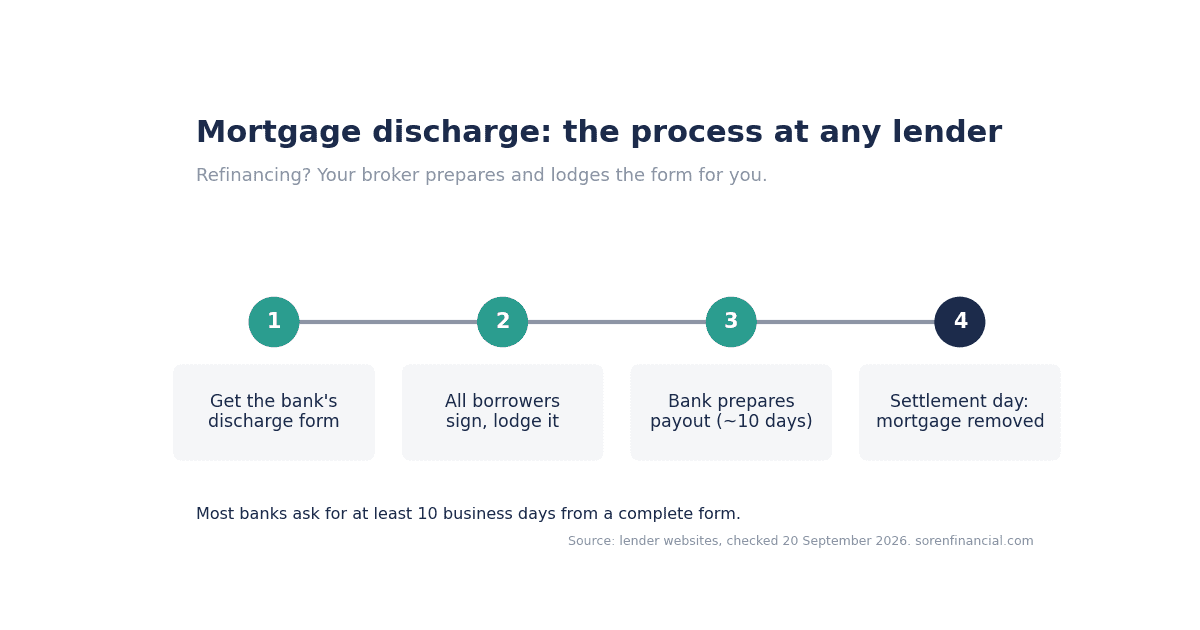
Quick answer. A mortgage discharge form (most banks call it a discharge authority) is the document you sign to tell your lender to remove its mortgage from your property’s title. You need one when you sell, when you pay the loan out, and when you refinance to another lender. Every bank has its own version; they are linked below. Expect a bank discharge fee of roughly $160 to $350, the NSW government’s $182.73 registration fee, and around ten business days from lodging the form to being settlement-ready. If you are refinancing through a broker, the broker prepares and lodges the form for you.
Refinancing? Talk to us before you send the form
Soren Financial covers up to $800 of the fees your outgoing and incoming lenders charge you. We prepare and lodge the discharge paperwork for every client we refinance. Reach out and we can have your discharge lodged within 24 to 48 hours. Answer a few quick questions about your loan, or call us now.
What a mortgage discharge form actually does
When you borrowed, the bank registered a mortgage over your property. That is what stops you selling it without paying the bank back. Paying the loan to zero does not remove the mortgage; ANZ’s own page says so in as many words. The discharge form is your written instruction to the bank to release it, and the bank then lodges a Discharge of Mortgage with the state land registry so the title is clean.
You will need it in three situations. Selling: the buyer’s lender wants a clean title at settlement. Refinancing: the new lender wants to be the only mortgage on the title, so the old one has to come off the same day. Paid it off: you want the title in your name alone, with no bank on it.
How the process works at every lender
- Get the form from your bank. Some are PDFs, some are online, and a few banks will only send it after you phone them. The table below tells you which.
- Fill it in: loan account numbers, property address and title reference, why you are discharging, who is acting for you (solicitor, conveyancer, or incoming lender and broker), and where surplus money should go.
- Every borrower and guarantor signs. Some banks accept a digital signature; ANZ, for one, insists on pen and paper.
- Lodge it: usually by email to the bank’s discharge team. Note the date.
- The bank works out a payout figure, including any fees and break costs, and tells your solicitor or the incoming lender when it is ready to settle.
- Settlement day: the old loan is paid out, the discharge is lodged with the land registry, and the linked accounts close.
What it costs
| Cost | Typical amount | Notes |
|---|---|---|
| Bank discharge or settlement fee | $160–$350 (as at 20 September 2026) | Westpac, NAB, CommBank and St George charge $350. ANZ charges three separate $160 fees. See each lender page for the source. |
| Fixed-rate break cost | Individually calculated | Only if you leave during a fixed period. Can be thousands. Get the quote before you commit. |
| Government registration fee (NSW) | $182.73 incl. GST (as at 20 September 2026) | NSW Land Registry Services 2026/27 fee schedule. Other states and territories set their own fees. |
| Your solicitor or conveyancer | Varies | Only if you are selling. A refinance usually does not need one; the incoming lender’s settlement team and your broker handle it. |
How long it takes
ANZ, NAB and St George all say at least ten business days from receiving a complete form. Westpac and CommBank do not publish a number for home loans; we plan for the same ten days with them and check with the bank on each file. Bendigo Bank asks for up to 15 business days’ notice.
The delays we see are almost never the bank being slow. They are a form with the wrong account number, one borrower who has not signed, a guarantor nobody thought about, or a settlement date that moved without the discharge team being told. Lodge a complete form once and the clock starts that day.
The traps
Discharging before the new loan is unconditional. A discharge form is an instruction to leave. If the new lender’s approval is still conditional and then slips, you have a payout ready and nothing to pay it with. Formal, unconditional approval first. Always.
The offset sweep. At settlement the bank clears the loan and closes the accounts linked to it, including your offset. Decide where that money goes before the day, and check the offset was doing its job while it was open. How to check if your offset account is working walks you through it.
Fixed-rate break costs. On a large loan with time left on the fixed rate, the break cost can be bigger than the saving from switching. That does not mean don’t switch; it means get the number and pick the date with your eyes open.
Two loans, or none. The old loan has to be paid out on the day the new one settles. Get the timing wrong and you either pay interest on both or your new lender is sitting on funds waiting for the old bank. Someone has to own that date. When we refinance a client, that is us.
Discharge forms by lender
Every link below goes to the lender’s own website, not a copy of the form. Banks change their forms and a copy hosted elsewhere may be out of date or rejected. Every lender in the table has its own guide, linked in the last column, and our cost to switch calculator will tell you whether leaving is worth it once you have the fee.
| Lender | Bank’s discharge fee | Official discharge page | Format | Our guide |
|---|---|---|---|---|
| Westpac | $350 | westpac.com.au | Online form | Westpac discharge form |
| ANZ | $160 | anz.com.au | PDF (wet signature) | ANZ discharge form |
| NAB | $350 | nab.com.au | PDF (digital signature OK) | NAB discharge form |
| Commonwealth Bank | $350* | commbank.com.au | Online form, then print and sign | CBA discharge form |
| St George | $350 | stgeorge.com.au | Online form or PDF | St George discharge form |
| Macquarie | $400* | macquarie.com.au | PDF, emailed | Macquarie discharge form |
| Bankwest | Not published | bankwest.com.au | Request in app or online banking; bank sends the form | Bankwest discharge form |
| ING | Not published | ing.com.au | Online form | ING discharge form |
| Suncorp Bank | $350 | suncorpbank.com.au | Phone 13 11 75; bank sends the form | Suncorp Bank discharge form |
| ME Bank | $350 | mebank.com.au | PDF, emailed | ME Bank discharge form |
| HSBC | $395 | hsbc.com.au | Phone or branch | HSBC discharge form |
| Bank of Melbourne | $350 | bankofmelbourne.com.au | Online form or PDF | Bank of Melbourne discharge form |
| BankSA | $350 | banksa.com.au | PDF or phone | BankSA discharge form |
| Bendigo Bank | $350 | bendigobank.com.au | Bendigo Bank discharge form | |
| Bank of Queensland | $350 | boq.com.au | Phone 1300 764 439; bank sends the form | BOQ discharge form |
Free through Soren Financial. When we refinance you, we cover these fees for you, up to $800 across your outgoing and incoming lenders. Each figure is the bank’s main discharge fee from its own fee schedule, checked November 2026 (* as at 20 September 2026). Other bank and government fees can apply; each bank’s page has the full list.
Links checked and updated November 2026. If a bank has moved its page since, search “[bank name] discharge” on the bank’s own site rather than downloading a copy from somewhere else.
Refinancing? You don’t need to do any of this yourself
Soren Financial covers up to $800 of the fees your outgoing and incoming lenders charge you. When Soren Financial refinances a client, we prepare the discharge authority for whichever bank you are leaving, tell you exactly where to sign, lodge it, chase the discharge team for the payout figure and any break cost, and book settlement so the old loan closes the day the new one opens. The incoming lender pays us. You get the paperwork done and one person to ring. Reach out and we can have your discharge lodged within 24 to 48 hours.
Run the numbers before you send the form
A discharge is worth doing when the new loan beats the old one after every fee above. Our calculators do that maths:
- Cost to switch calculator — the one to start with: it takes the discharge fee, the government fee and any break cost and tells you how many months until the switch has paid for itself.
- Loan repayment calculator — the new lender’s rate against your current repayment.
- Borrowing power calculator — a quick check that the new lender will actually lend you the amount before you tell the old one you’re leaving.
- Home loan offset calculator — what an offset account is worth to you at the new lender.
- Offset account checker — confirm the old bank was crediting your offset correctly before that account closes for good.

Written by Mansour Soltani, Director, Soren Financial. Mansour has arranged refinances across the major banks and the non-bank lenders since 2019, and handles the discharge paperwork for every client Soren moves. Certificate IV and Diploma in Finance and Mortgage Broking Management. FBAA member. Credit Representative 527161 of Finsure Finance and Insurance Pty Ltd, Australian Credit Licence 384704.
Frequently asked questions
What is a mortgage discharge form?
It is the signed instruction from you to your lender to remove its mortgage from your property’s title. Banks call it a discharge authority, a discharge and variation authority, or a property and security request. You need it when you sell, refinance, or have paid the loan out.
How much does it cost to discharge a mortgage?
The bank’s own fee is usually $160 to $350, then the state registration fee ($182.73 in NSW as at 20 September 2026), then any fixed-rate break cost. Break costs are the only one that can be large.
How long does a mortgage discharge take?
Most banks ask for at least ten business days from a complete form. Some do not publish a time; check with your bank and lodge early.
Do I need a solicitor to discharge my mortgage?
If you are selling, your conveyancer or solicitor handles it as part of the sale. For a refinance, the incoming lender’s settlement team and your broker manage it and you usually do not need a solicitor.
Can a mortgage broker do the discharge for me?
Yes. It is a normal part of a refinance. We prepare and lodge the form, chase the outgoing bank, and line the payout up with the new lender’s settlement.