
Construction Loans Sydney: build, knockdown rebuild and duplex finance
By Kylie Soltani, Co-Director, Soren Financial. Last updated November 2026.
A construction loan pays your builder in stages as the house goes up. You only pay interest on the money that has actually gone out, not on the full loan. Soren Financial arranges construction loans for new builds, knockdown rebuilds, duplexes and granny flats across Sydney. We compare more than 50 lenders, and our co-director Kylie Soltani spent almost 20 years as an architect before she became a broker.
50+
lenders compared
20
years in architecture and design
6
build stages, each one checked
$0
broker fee for most home loans
On this page
- How a construction loan works
- The six progress payments
- What lenders need before they’ll approve a build
- Where Sydney builds go wrong with the bank
- Kylie Soltani: a broker who has spent her career on building sites
- Types of construction loans we arrange
- A worked example: knockdown rebuild in Sydney
- How we work with you
- Construction loan FAQs
How a construction loan works
A normal home loan pays out the full amount on settlement day. A construction loan can’t do that, because the house doesn’t exist yet. So the lender releases the money in instalments, called progress payments, as each stage of the build is finished.
Before each payment goes out, the lender’s valuer checks the work on site. The builder sends an invoice for the stage, you sign off on it, the valuer confirms the work is done, and the lender pays the builder directly.
During the build you usually pay interest only, and only on what has been drawn. In month two you might owe interest on $150,000. By month ten it could be $700,000. Once the house is finished, the loan rolls over to a normal principal-and-interest home loan.
The six progress payments
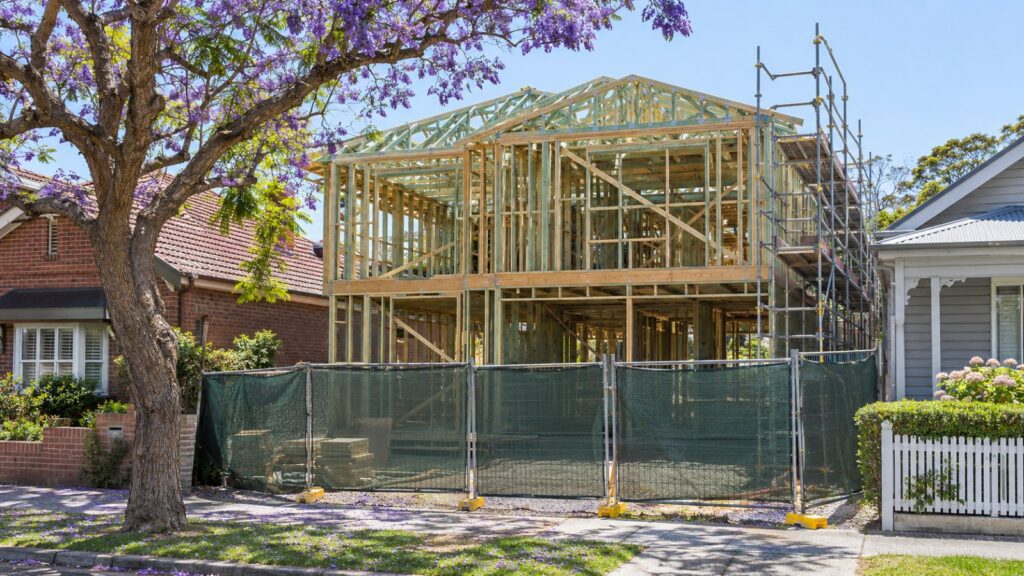
Most residential building contracts in NSW follow a similar stage schedule. The percentages vary by builder and contract, so always check your own. Here’s a common split on an $800,000 build contract:
| Stage | What's finished | Typical share | On an $800,000 contract |
|---|---|---|---|
| Deposit | Contract signed | 5% | $40,000 |
| Base | Slab or footings poured | 15% | $120,000 |
| Frame | Wall and roof frames up | 20% | $160,000 |
| Lock-up | Walls, roof, windows and external doors on | 35% | $280,000 |
| Fixing | Internal fit-out, cabinets, doors, plaster | 20% | $160,000 |
| Practical completion | House finished and ready for handover | 5% | $40,000 |
In NSW a builder can’t ask for a deposit of more than 10% on a residential job. If your contract asks for more, raise it before you sign.
What lenders need before they’ll approve a build
Construction loans carry more paperwork than a standard purchase. Most of the delays we see come from one missing document, not from the lender saying no. Expect to provide:
- a signed fixed-price building contract with a licensed builder
- council approval: either a development application (DA) or a complying development certificate (CDC)
- the stamped plans and the full specifications
- the builder’s licence details and a Home Building Compensation Fund certificate (in NSW this insurance is compulsory on residential work over $20,000)
- a quote for anything outside the main contract, like the pool, landscaping or driveway, if you want it in the loan
- your normal income and identity documents
The lender then values the property “as if complete”. That on-completion value, not the land price, is what decides how much it will lend.
Where Sydney builds go wrong with the bank
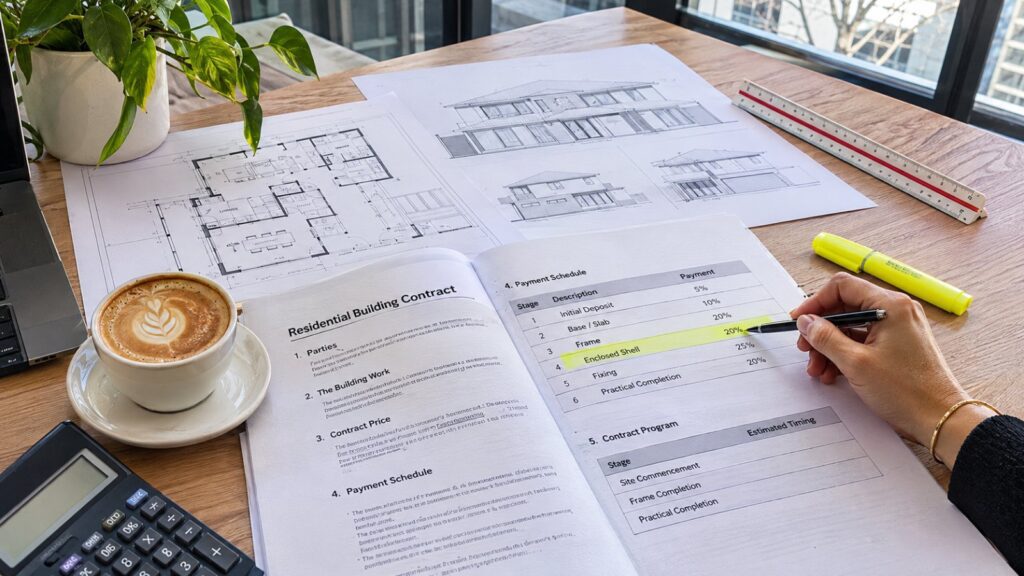
These are the problems we see most often, and nearly all of them can be fixed before the loan goes in.
Provisional sums that are too low. A provisional sum (or PC item) is a placeholder in the contract for something not yet priced, like rock excavation, tiles or appliances. If the allowance is low, the real cost turns up mid-build, and the lender won’t fund it. You pay the gap in cash.
Your money goes in first. If you’re contributing savings, most lenders want that money spent on the early stages before they release anything. People are often caught out when the bank says “the next invoice is yours”.
Variations after approval. Changing the kitchen or adding a room halfway through means a new contract price. The loan was approved on the old one. Some lenders will reassess and some won’t, so the extra cost usually comes out of your pocket.
The valuation comes in short. Builds with expensive finishes on a modest street can value below cost. Valuers price what the market will pay for the finished house, not what you spent on it.
Build time limits. Lenders expect the work to start within a set time after approval and finish within a set period, often somewhere around 12 to 24 months. A DA that takes longer than expected can mean re-applying.
Kylie Soltani: a broker who has spent her career on building sites
Before she became a broker, Kylie spent almost 20 years as an architect and design leader. She was Studio Design Principal at Scentre Group, the owner of Westfield in Australia, where her work included the $355 million Westfield Knox redevelopment. Before that she spent 11 years at HDR | Rice Daubney, leading projects like Wollongong Central and Edmondson Park Town Centre, and was part of the team behind the Chris O’Brien Lifehouse at RPA.
So when you bring her a build, she reads the plans, the specifications and the builder’s contract, not just the loan application. She can usually tell you what’s missing from a contract before the valuer does.

The bank looks at the numbers. I look at the build. Most of the problems I find are sitting in the contract on day one: a provisional sum that's half what the job will cost, or a lock-up payment that's too big for what's actually done on site. If we fix that before the loan goes in, the build is a lot calmer.
Kylie Soltani, Co-Director, Soren Financial
Certificate IV and Diploma in Finance and Mortgage Broking. FBAA member. Credit Representative Number 563104 under Finsure Licence 384704.
Types of construction loans we arrange
Building a new home on land you own. The land is the security. If it’s paid off, its value counts towards your deposit.
Buying land and building. Two steps under one approval: the land purchase settles first, then the construction loan pays the builder. Lenders look at the land loan and the build as one deal from the start.
Knockdown rebuilds. Very common in Sydney’s established suburbs. Your current home is demolished, so the lender values the block plus the finished new house. You’ll also need somewhere to live for the build, which needs to be in your budget.
Duplexes and dual occupancies. Building two homes on one block, to live in one and rent the other or to sell. Lenders treat these differently depending on whether you’ll strata or Torrens title them and what you plan to do with each half. If you’re splitting the block for sale, see our land subdivision finance page.
Granny flats. A secondary dwelling built in the backyard. Often funded with a loan increase against the existing home rather than a full construction loan, if the cost is modest.
Owner builders. Harder, because most lenders want a licensed builder carrying the risk. A small number will lend to owner builders at a lower loan size, with tighter conditions.
Building more than two dwellings, or building to sell? That’s development finance, a different type of lending. See property development finance.
A worked example: knockdown rebuild in Sydney
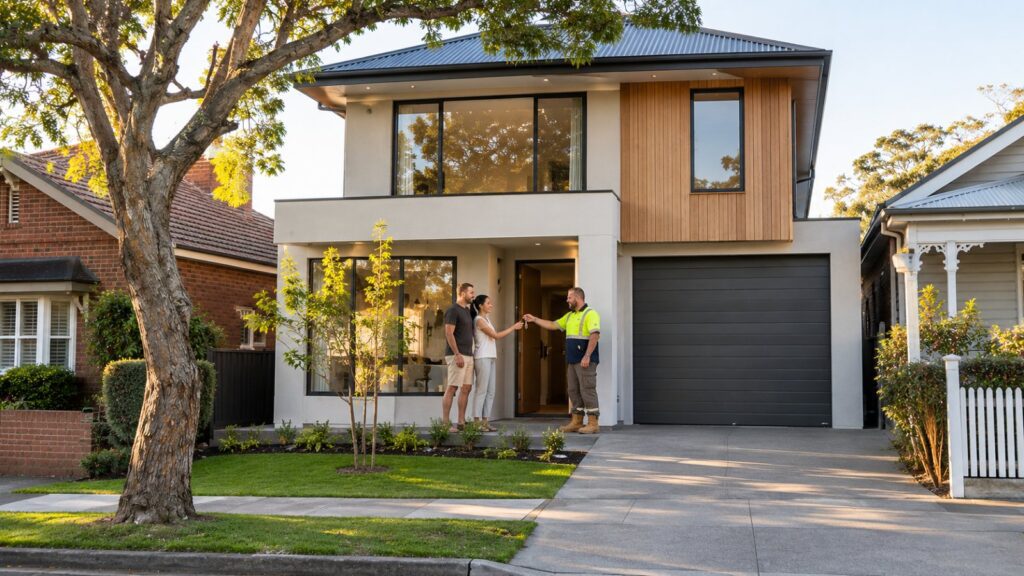
Sarah and Tom own a house worth $1.4 million, mostly for the land. They owe $350,000. They’ve signed an $850,000 fixed-price contract for a knockdown rebuild, plus $40,000 for demolition and site costs.
- The lender values the finished home at $2.4 million.
- Total borrowing: $350,000 + $850,000 + $40,000 = $1,240,000.
- That’s about 52% of the completed value, well inside most lenders’ limits.
- During the build they pay interest only, starting on $350,000 plus whatever has been drawn.
- They also need to cover rent for roughly 12 months while the house is built. Lenders count that cost when they work out what Sarah and Tom can afford.
These figures are an illustration only, not an offer of credit. Your numbers depend on the lender, the valuation and your income.
How we work with you
- A call first. Tell us about the block, the build and the budget. We’ll tell you straight whether it looks lendable and what’s missing.
- Contract and plans review. Kylie looks over the building contract, the provisional sums and the payment schedule before anything goes to a lender.
- Lender match. We compare banks and non-bank lenders on build-loan rules, valuation approach and how they handle progress payments, not just the rate.
- Approval and progress payments. We stay on the file through the build, chasing each payment so the builder isn’t held up.
- Conversion. When the house is finished, we check the loan has rolled to the right structure and offset setup.
Construction loan FAQs
Is a construction loan more expensive than a normal home loan?
Some lenders price them the same as their standard home loan and some add a small margin or fees for the progress inspections. Because you only pay interest on what’s been drawn, the cost during the build is usually lower than people expect. We can’t quote rates before a full assessment, but we’ll show you the difference between lenders once we know your situation.
How much deposit do I need to build?
Usually 10% to 20% of the total cost of land plus build. Some lenders accept 5%, with lenders mortgage insurance. If you already own the land, its value can count towards that.
Can I use a construction loan for a renovation?
Yes, if the renovation is structural and has a building contract, like an extension or a second storey. For cosmetic work, a loan increase is usually simpler.
What happens if my builder goes broke during the build?
In NSW, the Home Building Compensation Fund insurance covers you if your builder dies, disappears or becomes insolvent and can’t finish the job. That’s one of the reasons lenders insist on seeing the certificate before approval.
Can I get a construction loan with a fixed-rate loan?
Most lenders keep the loan variable during the build and let you fix after completion. A few allow fixing part of the loan earlier.
How long does approval take?
Pre-approval can take a few days. Full approval needs the signed contract, the council approval and the valuation, which usually takes two to four weeks once every document is in.
Got a build coming up?
Leave your details and we’ll call you back to talk it through.
Why choose Soren Financial for your construction loan?
- A co-director who spent nearly 20 years as an architect and design leader before broking
- More than 50 lenders compared, including banks and non-bank lenders
- We review your building contract and payment schedule before the loan goes in
- We stay on the file through every progress payment
- Office in North Sydney, working with clients across Sydney and NSW
Planning a build? Talk to Kylie before you sign the contract.
Soren Financial, Suite 1, 225 Pacific Highway, North Sydney NSW 2060. Phone 1300 899 819.
General information only. It does not take into account your objectives, financial situation or needs. Lending criteria, fees and charges apply. Soren Financial Pty Ltd, Credit Representatives of Finsure Finance & Insurance Pty Ltd, Australian Credit Licence 384704.