
Self-Employed Home Loans Sydney: when your tax return doesn’t tell the whole story
Your accountant spent all year legally shrinking your taxable income. Now your bank wants to use that same number to decide what you can borrow, off a return that’s already months out of date. We build the case around where your business is actually heading. And we know which of our 50+ lenders will assess it that way.
4.9★
from 105 client reviews
50+
residential lenders on panel
20+ years
in lending
North Sydney
lending Australia-wide
On this page
Why the banks keep saying no
If you run your own business you’ve had this conversation. You’re profitable. Cash flow’s fine. Then you walk into your own bank and they ask for two full years of tax returns, and assess you on the taxable income sitting at the bottom of them.
That number is deliberately low. Your accountant spent the year making it low. Depreciation, vehicle costs, home office, extra super, profits left sitting in the company. All of it legitimately cuts what you pay tax on. All of it cuts what a bank thinks you can afford.
Good tax planning and good borrowing capacity pull in opposite directions. The big banks only ever read one side of that.

Those two jobs are working against each other, and nobody warns you about it until you apply. My job is knowing which of our 50+ lenders will look past the bottom line on the tax return and actually assess how the business is trading.
Mansour Soltani
Director | Soren Financial
Certificate IV and Diploma in Finance and Mortgage Broking Management. FBAA member. AFCA member. Finsure Licence 384704. Credit Representative Number 527 161.
“Low doc” is gone. What you want is alt doc
Plenty of people still search for a low doc home loan, so let me be straight with you. The old low doc loan, where you declared an income and nobody checked it, doesn’t exist anymore. It got pulled because it didn’t let lenders meet their responsible lending obligations. If you find a site still advertising one, be careful.
What replaced it is alt doc, short for alternative documentation. You still have to prove your income. You just get to prove it with something other than two years of finished tax returns.
Depending on the lender, that proof might be:
- Business Activity Statements. Usually the last six or twelve months, showing turnover.
- Business bank statements. Six to twelve months of money actually landing in the account.
- A signed declaration from your accountant confirming your income.
- One year of tax returns instead of two.
That’s the whole game. Every lender has its own appetite for which of those it’ll accept, how long you need to have held your ABN, and how it treats add-backs. Nobody publishes a tidy comparison of it, because it shifts constantly and most of it lives in credit policy rather than on a website.
If you came here searching for a low doc loan specifically, there’s more on what replaced it and what it costs on our low doc home loans page.
The actual strategy: proving where your business is going, not where it’s been
A tax return is a rear-view mirror. It describes a financial year that ended months ago. If your business has grown since, that return understates you, and it gets more out of date every month you wait.
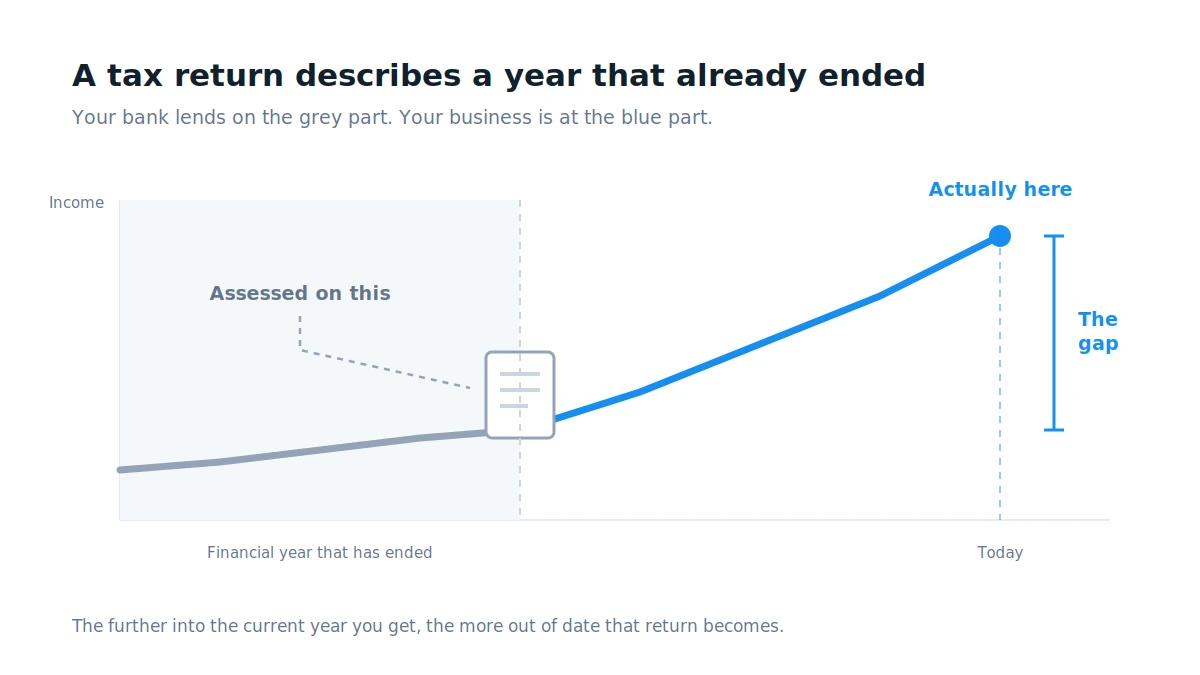
Lenders know this. They accept that last year’s financials often don’t say much about where a business is now. What they need is someone credible to confirm where it actually is, and that’s your accountant.
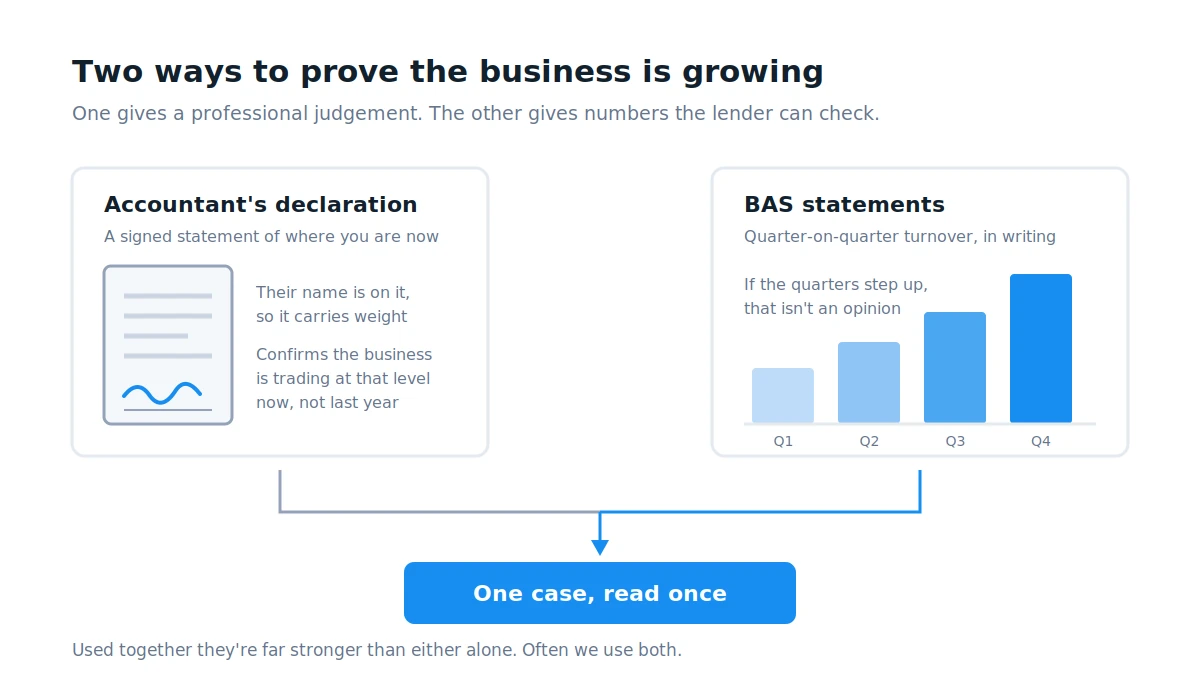
Two ways to evidence it, and we’ll often use both.
An accountant’s declaration confirms your current income and, more importantly, that the business is trading at that level now rather than at last year’s level. It carries weight because your accountant is putting their name to it.
BAS statements show quarter-on-quarter turnover. If the last four quarters step upward, that isn’t an opinion. It’s data the lender can check for itself.
Together they’re far stronger than either alone. A lender gets a professional judgement, and the figures to sit behind it.
Which is why I’d rather talk to you before you apply anywhere. Building this case takes some coordination between you, your accountant and me, and it’s very hard to reconstruct once a lender has already declined you off the tax return.
You don’t always need two years. But there’s a catch
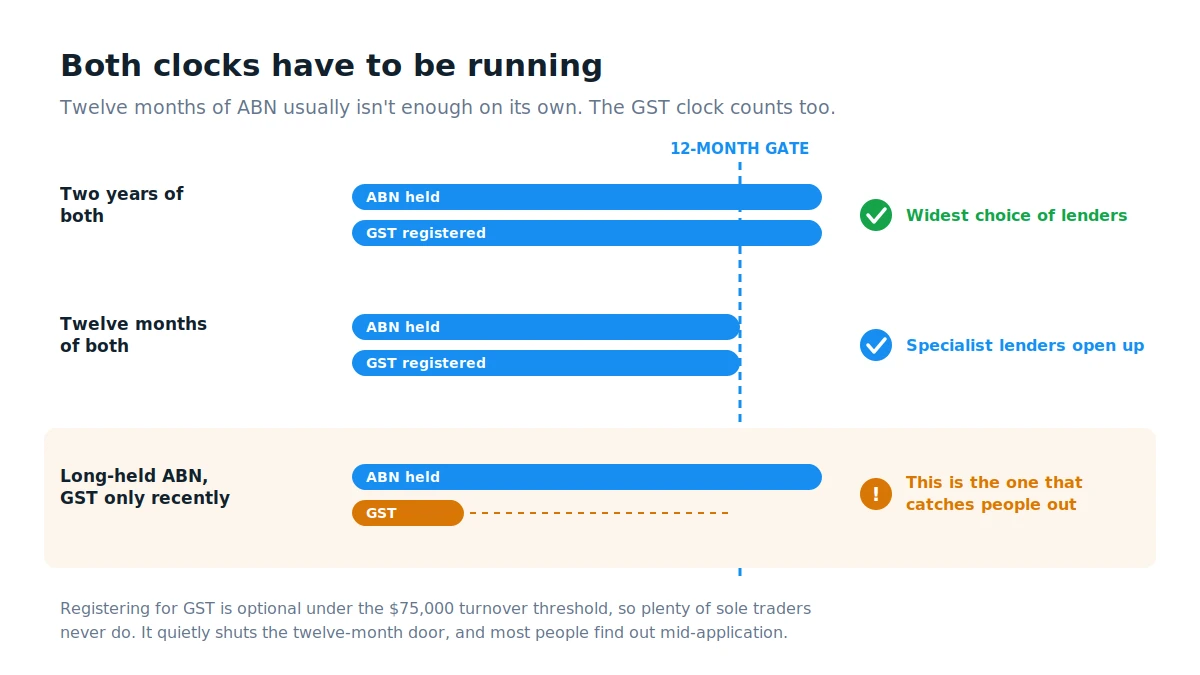
Most of the specialist lenders in this space will work with twelve months of ABN history instead of two years. That one fact is the difference between “come back next year” and buying now.
There’s a condition attached, though, and it catches people out constantly. To use the twelve-month route you generally need to be registered for GST as well.
Plenty of business owners aren’t.
If your turnover is under the $75,000 threshold, registering is optional. So a lot of sole traders and newer companies never bother, which is a perfectly reasonable call to make. It just quietly shuts the twelve-month door, and most people only find out when they’re already mid-application.
Under twelve months isn’t automatically the end of it either. We have lenders who’ll look at a six-month ABN. The conditions get tighter and the pricing reflects that, but “I’ve only been going six months” is a conversation, not a no.
Two questions to answer before anything else. How long have you held your ABN? And are you registered for GST, from what date?
If you’re thinking about buying in the next year or two and you’re not registered, have that conversation with me and your accountant now rather than at application time. Timing matters a lot here.
Add-backs: where the number really moves
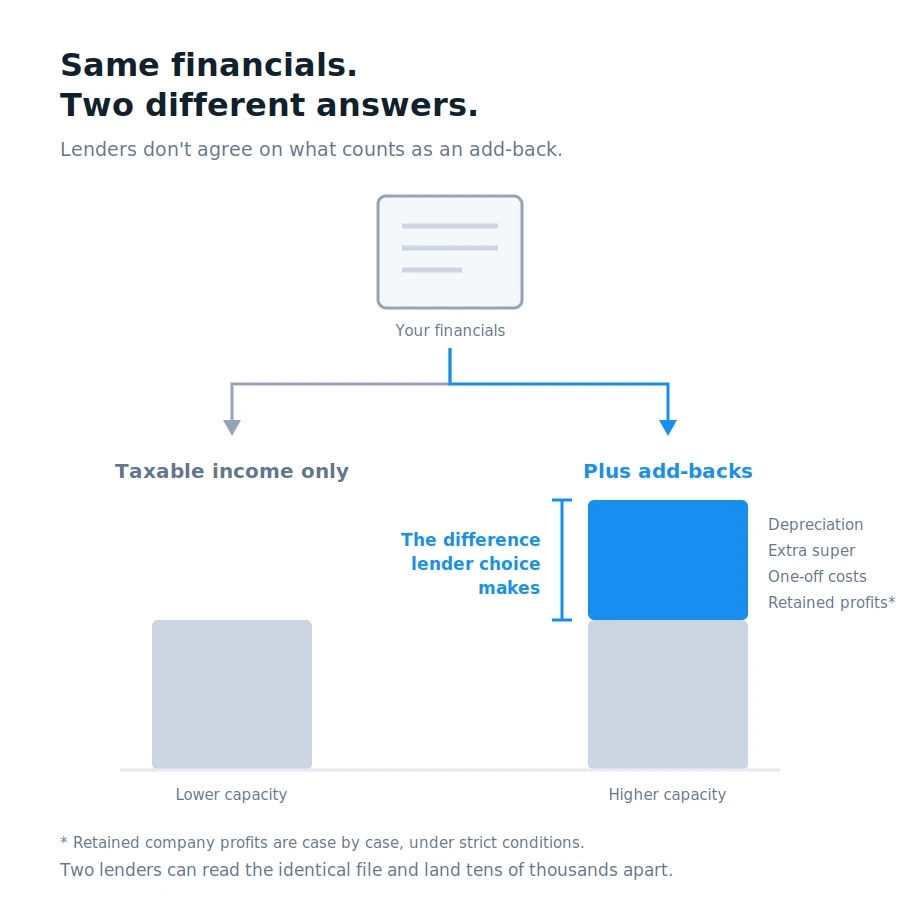
An add-back is an expense a lender will add back onto your taxable income, because it isn’t money leaving your pocket in a way that affects your ability to pay a mortgage.
The usual candidates:
- Depreciation. A paper expense, not cash out the door.
- Extra superannuation above the compulsory rate, where it’s discretionary.
- Genuine one-off costs, evidenced.
- Interest on debt that’s being refinanced away as part of the deal.
- Company profits retained in the business. Possible, but case by case and under strict conditions. Never assume this one is coming.
- Rent your business pays you on a property you own.
Lenders don’t agree on that list. One allows depreciation and retained profits. The next allows depreciation and stops. Two lenders can read identical financials and land tens of thousands of dollars apart on your borrowing capacity, sometimes a lot more than that.
That gap is the main reason you’ll get a different answer from me than you got from your own bank.
How these applications actually get put together
Illustrative scenarios based on typical lender policy as at August 2026. These show how applications get structured. They are not records of specific clients. Every application is assessed on its own merits and outcomes vary.
Sole trader who can’t wait for a second tax return
An electrician has held his ABN for fourteen months and registered for GST on day one. A second year of returns doesn’t exist yet, so his own bank tells him to come back next July. His BAS lodgements cover the full twelve months and show turnover running around $210,000, with the last two quarters ahead of the first two. A specialist lender that opens at twelve months of ABN and GST history assesses him on the BAS rather than a return he hasn’t lodged. He buys this year instead of next.
Where the value is created: knowing which lenders open at twelve months, and checking the GST date before anything else. Had he never registered, this doesn’t work.
Company director whose wage isn’t the whole picture
A director of a services company pays herself $95,000 and leaves the rest of the profit in the business. Her bank assesses the $95,000 and stops there, which caps her well below what she was expecting. The same financials also carry roughly $28,000 of depreciation and $15,000 of discretionary super above the compulsory rate. A lender that adds both back, and looks through to company profit under its own conditions, assesses her on a much larger figure off an identical set of documents.
Where the value is created: matching the add-back policy to the shape of the business before the application goes anywhere. Retained profit is never a given, so the lender shortlist gets built around who will and won’t consider it.
Declined by their own bank off a bad year
A couple running a café are declined in March. The return the bank assessed covers a year that included a three-month fit-out shutdown, so the income looks thin. Nothing about the decision is wrong on the numbers in front of the bank. The problem is the numbers in front of the bank. Re-cased three months later with a declaration from their accountant confirming current trading, plus four quarters of BAS showing the recovery, the same business reads completely differently, and it goes to a lender that accepts that evidence.
Where the value is created: rebuilding the evidence before the second application, rather than shopping the same file around until someone says yes.
Who we do this for
| Your situation | What usually matters most |
|---|---|
| Sole trader | How long you’ve held the ABN, and whether BAS or bank statements can carry the income assessment. |
| Company director paying yourself a wage | Whether the lender looks through to company profits, or only counts the wage you pay yourself. |
| Partnership or trust structure | How distributions get treated, and which lenders are comfortable with the structure. |
| Under two years self-employed | Twelve months of ABN history opens up several specialist lenders, provided you’re GST registered too. That second condition is the one nobody warns you about. |
| Contractor on an ABN | Some lenders treat a long-term contractor almost like a PAYG employee, which usually gets you the better rate. |
| Recently restructured | Whether your trading history carries across the restructure, or the clock started again. |
I’m based in North Sydney and most of my self-employed clients are Sydney business owners. Lending is national though, so we work with clients right across Australia.
What to have ready
You don’t need all of this to have a conversation. It’s what tends to be needed once we’re choosing a lender.
- Your ABN and how long you’ve held it
- Your GST registration status, and the date it started. More important than most people expect.
- Last two years’ returns and notices of assessment if you have them. One year is often enough.
- Your last four to eight BAS lodgements
- Six to twelve months of business bank statements
- Your accountant’s contact details
- Anything that shows growth since your last return. New contracts, more staff, higher recent invoicing.
- A rough idea of the purchase price, or the loan you want to refinance
Your accountant isn’t optional here
On a PAYG application your accountant never comes up. On this one they’re part of the case. They verify the growth, sign the declaration, and explain why last year’s number isn’t this year’s number.
A lot of my self-employed lending comes through accountants for that reason. They’re usually the first to hear “we want to buy a place” and the first to work out the tax return is going to make it awkward. If yours wants to talk structure and timing before you apply, happy to have that conversation with all three of us in the room. Here’s how we work with accountants.
And if you don’t have an accountant who’ll write a declaration, say so early. Solvable. Just not something to discover halfway through an application.
Not ready for a full application? Just leave your number.
Tell me roughly what you’re trying to do and I’ll call you back and tell you honestly whether it’s doable.
Free, no obligation, no pressure. We’ll only use your details to talk to you about your lending. Soren Financial — Credit Representative 527 161 under Finsure Group Australian Credit Licence 384704.
Questions we get asked
Can I get a home loan with one year of tax returns?
Often, yes. Several lenders will assess on a single year, particularly where the business has been trading longer than that one return covers and the trend is flat or improving. Not every lender does it, and the rate can sit a little above a full-doc rate.
Can I get a home loan without tax returns at all?
Sometimes, through alt doc. Instead of returns the lender looks at BAS, business bank statements or a signed accountant’s declaration. You’re still proving your income. You’re just proving it differently.
How long do I need to have held my ABN?
Most specialist lenders in this space can work with twelve months rather than insisting on two years, provided you’re registered for GST as well. Under twelve months is harder, and depends on how strong the rest of the application is. This is exactly why picking the right lender matters more than chasing the rate at the start.
Do I need to be registered for GST to get a self-employed home loan?
For the twelve-month ABN route, generally yes. It’s the single most common thing my clients don’t know. Registration is optional under the $75,000 turnover threshold, so plenty of sole traders never do it, then find the shorter-history options aren’t open to them. If you’re not registered and you’re planning to buy, talk to me and your accountant early. When you register affects how soon you can borrow.
I’ve been registered for GST for less than 12 months. What now?
Tell me the dates. “ABN for three years, GST for six months” is a different conversation to “both for six months”, and the answer changes depending which one you are. Five minutes on the phone beats guessing.
Will I pay a higher interest rate?
If we can get you assessed as full doc using add-backs, you’re usually on standard pricing. That’s always the first thing I try. If the application really does need alt doc, here’s the honest cost as at August 2026. The rate typically sits around 1% to 1.5% above a comparable full-doc rate. On top of that most alt-doc lenders charge a one-off risk fee of roughly 1% to 1.5% of the loan amount. That second one is what catches people. Plenty of comparison sites will quote you an alt-doc rate and never mention the risk fee, so the deal looks closer to a standard loan than it is. On a $800,000 loan a 1.25% risk fee is $10,000. Worth knowing before you fall in love with a property. I’ll show you both routes side by side, full doc and alt doc, with the fees in the comparison rather than in a footnote.
How much deposit do I need?
Alt doc lending commonly caps at 80% of the property value, so a 20% deposit plus costs. Some lenders go higher with lenders mortgage insurance. If you can be assessed as full doc, normal deposit rules apply instead.
My last financial year was weaker than this year. Does that kill it?
No, and I see it constantly. Lenders accept that a finished return describes a year that’s already over. The way through is evidence: a declaration from your accountant confirming where you are now, plus BAS showing the recent quarters trending up. Build that before you apply, not after a decline.
What is an accountant’s declaration and will my accountant do one?
It’s a signed statement from your accountant confirming your income and that the business is currently trading at that level. Most accountants know them well and provide one without fuss. If yours won’t, tell me early, because it changes which lenders I approach.
Does being self-employed hurt my borrowing capacity?
Being self-employed doesn’t. Being assessed on a tax-minimised taxable income does. Add-backs and lender selection are how we deal with that.
I was knocked back by my own bank. Does that hurt me?
Not automatically. Tell me about it up front though, so I don’t walk you into a lender likely to reach the same conclusion. Bring whatever reason they gave you.
Let’s find out what’s actually possible
Two minutes to tell me your situation. I’ll come back with what the lenders on my panel will actually do, rather than what a bank’s website says.
1/225 Pacific Highway, North Sydney NSW 2060
1300 899 819
Why choose Soren Financial?
- 50+ residential lenders on panel, including the specialist alt doc lenders the majors don’t compete with
- Alt doc, BAS, accountant’s declaration and one-year-return routes all assessed side by side
- Twelve-month ABN options where you’re GST registered, instead of waiting out a second year
- Add-backs worked properly, so we try full doc pricing before we settle for alt doc
- We work with your accountant, not around them
- 20+ years in lending, 4.9★ from 105 client reviews
- Based in North Sydney, lending Australia-wide