







Why this page exists
Most lending pages talk about rates and products. This one is narrower. It’s for the conversation you have with a client after you’ve already delivered the good news, the business is turning a profit, the numbers are heading the right way, and then have to explain why a bank still said no.
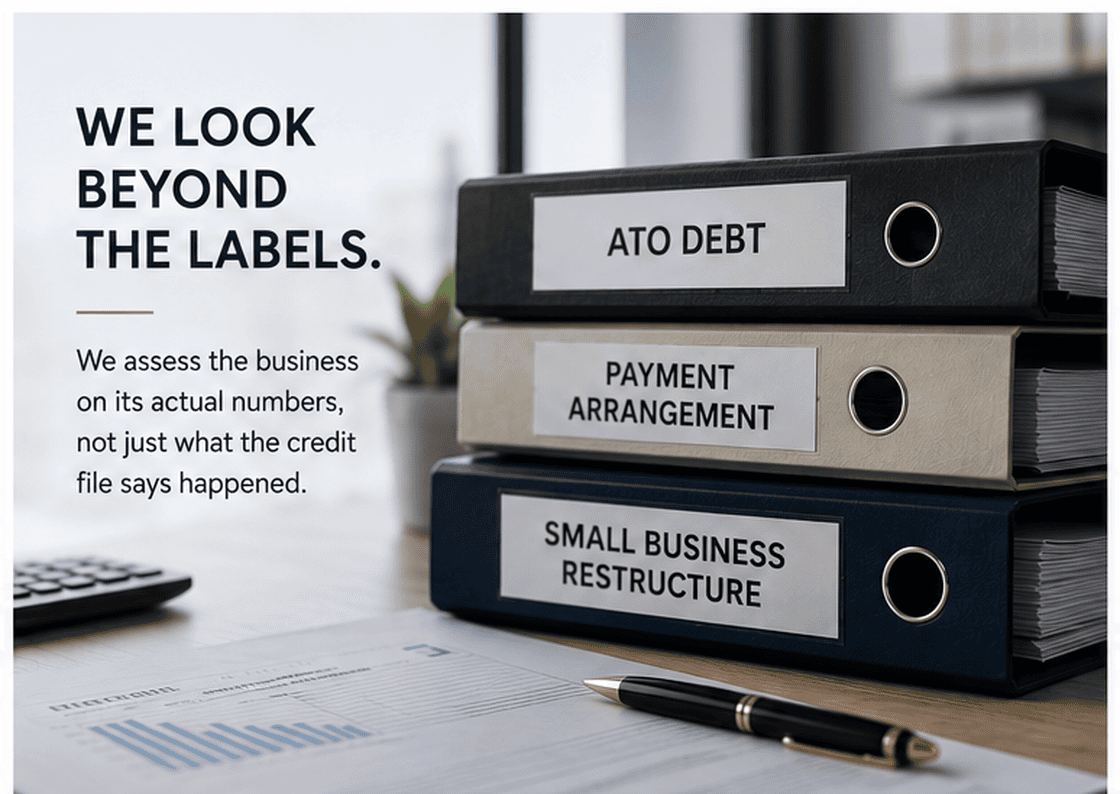
Two situations come up more than any others: a client managing ATO debt under a payment arrangement, or a client who’s recently come through a Small Business Restructure under Part 5.3B of the Corporations Act. Both are common. Neither means the business is finished. But both get treated by most mainstream lenders as an automatic decline, regardless of what the last six or twelve months of trading actually show.
You’re usually the first person to see this coming. ATO debt shows up on your desk before it shows up on a loan application, and if a client’s been through an SBR practitioner’s process, you were almost certainly the one who helped them through it. That puts you in a better position than most brokers to know whether a client’s situation has actually turned a corner, we just need a way to act on that.
That’s the gap we work in.
What lenders are actually looking at
For post-SBR clients, the two things that matter most are how the business has traded since the restructure, and whether the conditions that caused the original distress have actually changed. A restructure that cleared debt but left the underlying cost structure or pricing problem untouched is a different conversation to one where the business genuinely reset. Lenders who’ll consider these deals are looking for that distinction, and it’s usually visible in clean trading data since the restructure, current BAS lodgements, and a straightforward explanation of what caused the original distress and what’s different now.
For ATO debt, the read is similar. A payment arrangement that’s been running to schedule for six months or more tells a very different story than one entered into last month under pressure. We ask for the arrangement details, recent BAS and ATO statements, and a short explanation of what changed in the business to get the debt under control. That’s usually enough for us to tell you within a few days whether there’s a lender who’ll look at it, before anyone fills out a full application.
What to send through
You don’t need a complete file to test a scenario with us. To start, we usually just need the ATO payment arrangement letter or the SBR practitioner’s report and proposal, the last two BAS statements, and a short, plain explanation of what caused the debt or restructure and what’s changed in the business since.
That’s enough for a first read. If it’s not going to work with any lender we deal with, we’ll say so quickly rather than stringing the file along.
How we work with accountants
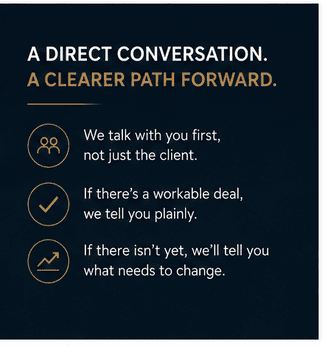
We’ll talk to you directly first, before the client, so you’re not sending someone into a process you can’t see the other side of. If there’s a lender who’ll assess the deal, we’ll tell you which one and roughly what they’ll want to see. If there isn’t one yet, we’ll say so, and tell you what would need to change for that to be different, a longer track record on the payment arrangement, another BAS cycle, a specific piece of documentation, so you’re not back here in six months with the same file and nothing new to show for it.
There’s no referral fee arrangement and no formal partner program to sign up for. This isn’t a pitch to become a preferred partner, it’s a standing offer to have the conversation before you refer a client anywhere, so the referral is worth making when you do.
Two things accountants usually ask
Will my client feel judged going through this?
No. We’re assessing a lending file, not relitigating what happened. The ATO debt or the restructure is one part of a bigger picture, current trading, direction of the business, what’s changed since, and that’s how we treat it.
What if the ATO debt is still being negotiated?
That’s worth a conversation before it’s finalised, not after. Knowing roughly where the arrangement is likely to land helps us tell you early whether there’s a realistic path once it’s signed, rather than waiting until everything is locked in and finding out then.
What if the SBR happened more than two years ago?
Worth asking regardless. The two-year figure is a rough industry rule of thumb, not a hard cutoff every lender applies the same way, some will look sooner if the trading history since is strong, others hold a longer line. It’s a five-minute conversation to find out which applies to a specific client rather than assuming the older answer still holds.
None of this is a guarantee that every file gets a yes. Some won’t, and we’ll say so plainly rather than taking a fee-generating deal nowhere. But a lot of accountants are sitting on clients they’ve quietly stopped referring anywhere, on the assumption that the ATO debt or the SBR makes the file untouchable. That assumption is usually wrong, or at least worth testing properly before it becomes the final word.
If you’ve got a client like this and you’re not sure whether it’s worth a conversation, call us before you decide it isn’t.
The client you refer most often is the one who looks unbankable on paper. Our page on self-employed home loans covers what lenders accept in place of payslips, including add backs and an accountant’s declaration on the direction of the business. For clients asking what our help costs them, how mortgage brokers get paid answers it in plain terms.