
Small business restructure: what it means for your home loan, your credit and your next loan
A small business restructure (SBR) is a formal process under the Corporations Act that lets a company with debts under $1 million put a repayment plan to its creditors while the directors keep running the business. It was introduced in January 2021. Most of the people who go through one owe the tax office. This page covers what the insolvency firms do not: what a restructure does to the director’s borrowing, and what the alternatives look like when there is property involved.

20+
commercial lenders
$100m+
commercial lending settled a year
4.9
stars from 100+ Google reviews
1 hour
call back in business hours
On this page: What a small business restructure is · Who qualifies · Not to be confused with the restructure rollover · What a restructure does to your borrowing · The alternative when there is equity in property · Case study · Getting a home loan after a small business restructure · Before you appoint a practitioner · Small business restructure FAQs
What a small business restructure is
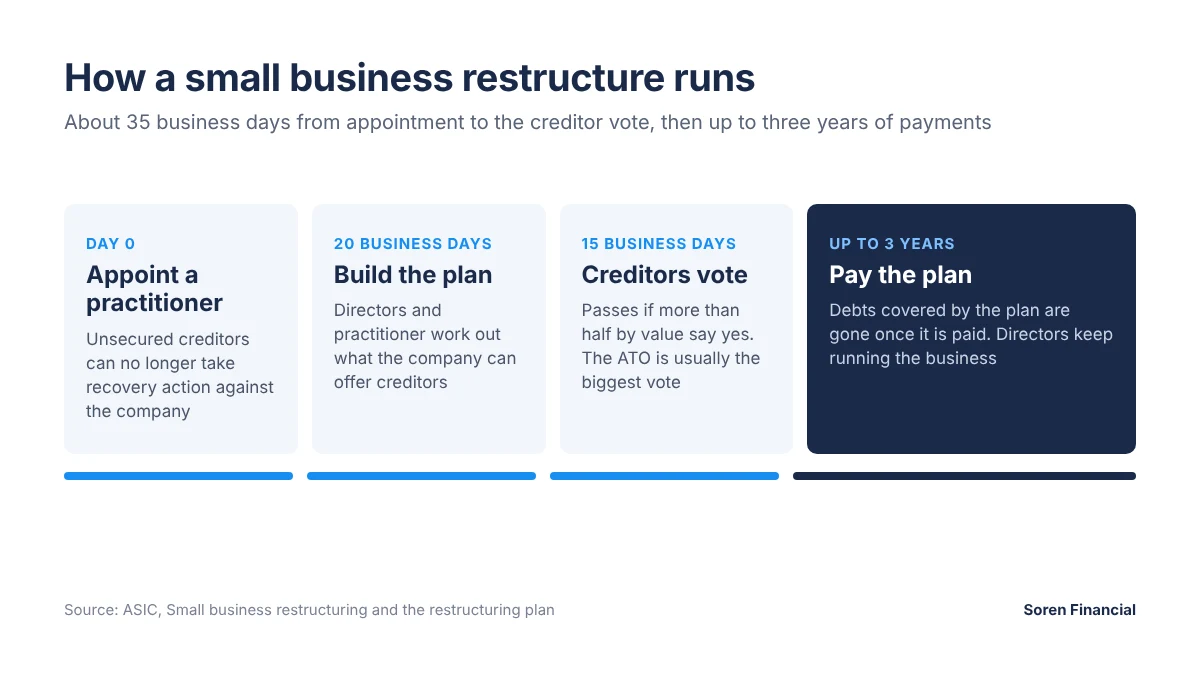
The company appoints a registered small business restructuring practitioner. From that day, unsecured creditors cannot take recovery action against the company. The directors and the practitioner have 20 business days to put together a plan, which usually offers creditors part of what they are owed, paid over up to three years. Creditors then have 15 business days to vote. If more than half of the voting creditors by value say yes, the plan binds all of them, including the tax office.
While the plan runs, the directors stay in charge and the business keeps trading. When the plan is paid out, the unsecured debts it covered are gone.
That is the short version. The ASIC and ATO pages linked at the bottom of this page carry the full rules.
Who qualifies
- The company is insolvent, or about to be
- Total liabilities are under $1 million, not counting employee entitlements
- Every tax lodgement is up to date, even if unpaid
- Employee entitlements, including super, are paid up
- No director has used a restructure or simplified liquidation in the past seven years
The lodgement rule catches a lot of people. A company two years behind on BAS cannot enter a restructure until the accountant has caught everything up.
Not to be confused with the restructure rollover
Search “small business restructure” and half the results are about something else: the small business restructure rollover. That is a tax rule that lets a growing business change its legal structure, say from a sole trader to a company, without paying capital gains tax on the move. It has nothing to do with debt. If that is what you are after, your accountant is the person to ask, not us.
What a restructure does to your borrowing
The insolvency firms tend to leave this part out. They are not the ones writing your next loan.

It goes on the public record
The appointment of a restructuring practitioner is recorded against the company on the ASIC register. Credit reporting agencies pick it up. Any lender that searches the company, or searches you as a director, will see it. It does not disappear when the plan is paid out.
Your personal guarantees survive
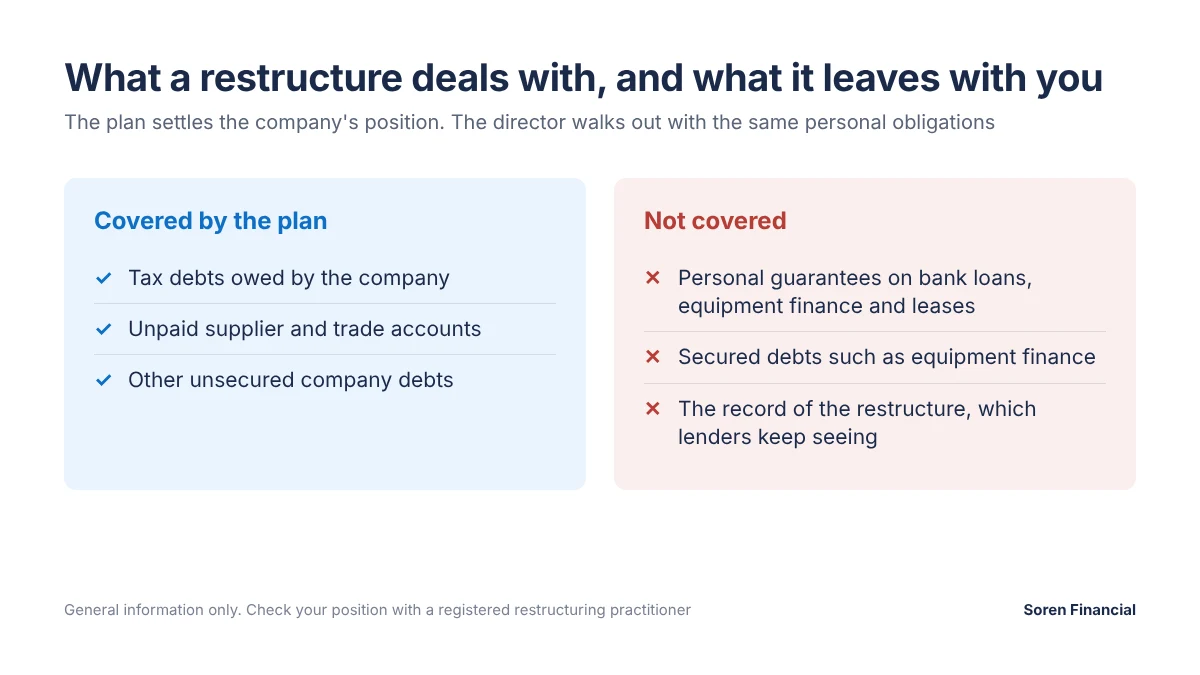
The plan deals with the company’s debts. Anything you signed a personal guarantee for, which is most bank facilities, most equipment finance and often the lease, is still yours. While the restructure runs, creditors cannot enforce those guarantees. Once the plan is in place, they can come to you for the shortfall. A restructure settles the company’s position, not the director’s.
Mainstream lenders go quiet for a while
Banks ask whether you have been a director of a company that went through an insolvency process. A restructure is one. For most bank home loan products, a yes means a decline, generally for a few years after the plan finishes. Non-bank lenders take a different view. They read the story behind it, look at the property and the current trading, and price the risk rather than refusing it. That is the gap a broker fills.
Your family home is not touched by the plan, but it is still in play
The restructure does not take your house. Your guarantees might. If a guaranteed debt is not covered by the plan and the creditor pursues you, the house is the asset they look at. This is why we ask every director to put the loan option on the table before they appoint anyone.

“The restructure is sold as a clean reset for the company, and for the company it often is. The director walks out of it with the same guarantees they walked in with, plus a mark on the record that every lender reads for years. Price the alternative first. If there is equity in property, a loan that pays the tax office in full can leave you in a far better position in two years’ time than a plan that paid them 40 cents in the dollar.”
Mansour Soltani, Director, Soren Financial. Certificate IV and Diploma in Finance and Mortgage Broking Management. FBAA member. AFCA member. Finsure Licence 384704. Credit Representative Number 527 161.
The alternative when there is equity in property
If you own property with room in it, a lender can pay the ATO out in full and leave you with one loan on a set term. The company owes nothing to the tax office, there is no insolvency appointment, your record stays clean, and the interest you pay may be deductible where the ATO’s own interest charge no longer is.
The full detail, the lender we use and a calculator that compares the two costs are on our tax debt loans page.
It does not suit everyone. If there is no property, or the business cannot carry a repayment, the loan only moves the problem and the restructure may well be the better road. We say that on the first call when it is true.
Case study: restructure, or refinance with MA Money?
An illustrative example built from the kind of deal we see. The business owner and the numbers are made up, the lending logic is real. It is not a quote.
Dan runs a joinery company in Western Sydney with nine staff. In 2025 a builder he worked for went into liquidation owing him $180,000. To keep wages going he stopped paying the tax office, and within eighteen months the company owed the ATO $265,000 in GST and income tax. It also owed suppliers about $55,000. Every BAS and return was lodged on time. The money just was not there to pay them.
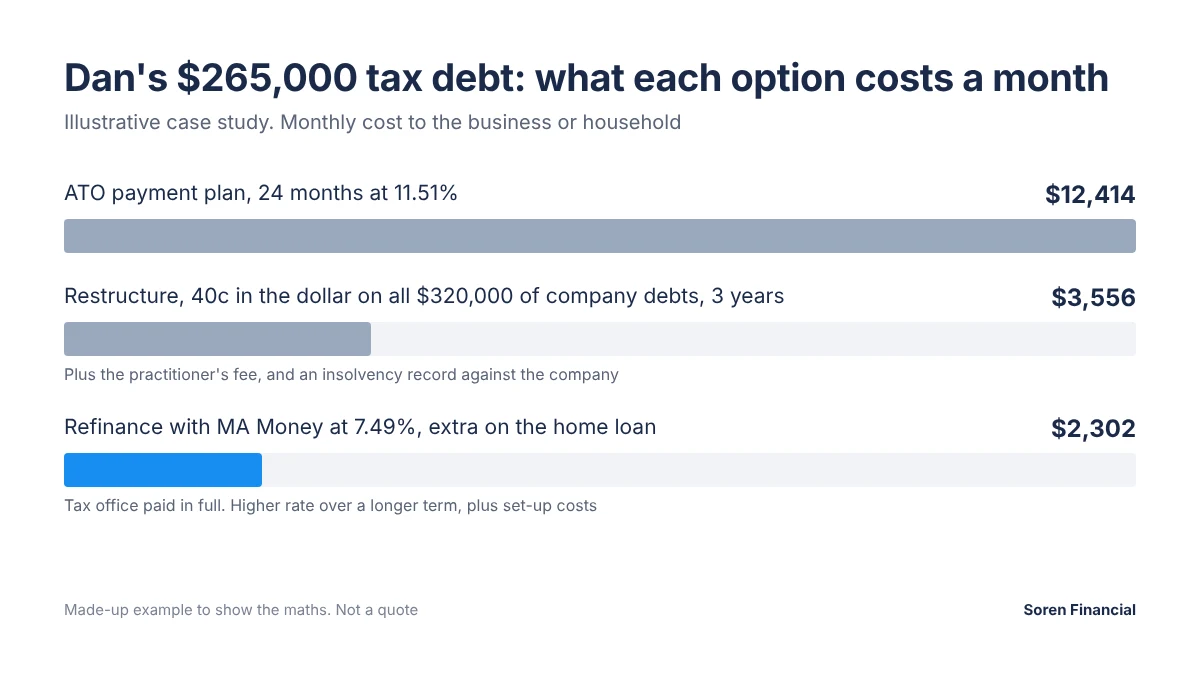
His accountant raised a small business restructure. With $320,000 of debt, Dan was well under the $1 million limit, and a plan offering creditors 40 cents in the dollar over three years looked achievable. The ATO had offered a 24-month payment plan, which worked out at about $12,400 a month. The business could not carry that.
Dan owns his home in Penrith, worth about $1.15 million, with $520,000 owing to his bank at 6.19%. He had also personally guaranteed the company’s equipment finance and the lease on the factory. That is where we came in.
What we did
We refinanced the home loan with MA Money, a non-bank lender that assesses the property and the story behind the debt rather than declining on the ATO arrears alone. The new loan was $785,000 at 7.49%, which paid out the bank and paid the tax office in full on settlement day. That left Dan borrowing about 68% of the home’s value.
His home loan repayment went from about $3,180 a month to about $5,480. That is roughly $2,300 a month more, against the $12,400 the ATO plan wanted. The suppliers were put on payment terms out of the business’s cash flow.
| Small business restructure | Refinance with MA Money | |
|---|---|---|
| What gets dealt with | $320,000 of company debts (ATO plus suppliers) | $265,000 ATO debt paid in full |
| Monthly cost | About $3,560 a month for three years, plus the practitioner’s fee | About $2,300 a month more on the home loan |
| Insolvency record | Yes, against the company, seen by every lender that searches Dan | None |
| Personal guarantees | Unchanged | Unchanged, and nothing has gone wrong to call them |
| Supplier debts | Cut to 40 cents in the dollar | Still owed in full, put on payment terms |
| Next bank home loan | Likely a few years away | Refinance to a bank once two years of clean trading are on the books |
Why it suited Dan, and what it cost him
There was no insolvency appointment against the company, so nothing goes on the public record and Dan can still answer “no” when a lender asks whether he has been a director of a company in an insolvency process. His guarantees were never tested, because nothing failed.
It was not free. The restructure would have wiped 60% of the supplier and tax debt, and the loan wipes none of it. Dan is now paying a higher rate than his bank, on a bigger loan, stretched over a longer term, plus MA Money’s set-up costs. The plan is to pay extra off the loan while the business recovers, then refinance back to a bank rate once there are two clean years of trading to show. If the business had no way of carrying the extra repayment, the restructure would have been the better call, and we would have said so.
Run your own numbers on our tax debt loans page, which has a calculator that compares an ATO payment plan with a loan.
Getting a home loan after a small business restructure
It can be done. What a lender wants to see:
- The plan was completed, or is on track, with no missed payments
- The business has traded cleanly since, with lodgements up to date
- A clear, one-cause explanation of what went wrong
- Property security with a sensible amount of equity
- Where the restructure was recent, a non-bank lender rather than a bank
The timing matters. Twelve months of clean trading after the plan opens far more doors than six. The rate will be above a standard bank rate for the first loan after the restructure. The usual path is to take that loan, build the record, then refinance to a cheaper lender once the restructure is a few years behind you.

“Directors come to us assuming the answer is no for five years. It is not. The first loan after a restructure is harder and dearer, but it exists, and it is the stepping stone to a normal rate later. What makes it impossible is a second blemish, so the business has to run clean from the day the plan is signed.”
Kylie Soltani, Co-Director, Soren Financial.
Before you appoint a practitioner
Before you sign anything, get your lodgements up to date, because both the restructure and a loan depend on it. Get a current figure on what the property would value at and what is owed on it. Then put the two roads side by side with real numbers: what the restructure costs in practitioner fees and what it leaves you owing personally, against what a loan costs over its term.

A practitioner is paid to run the restructure. A broker is paid when a loan settles. Neither of us is neutral, so get both numbers and decide with your accountant.
Small business restructure FAQs
Does a small business restructure affect my personal credit rating?
It is recorded against the company, and lenders search directors of companies that have been through an insolvency process. Expect it to come up on any application you make for several years.
Can I get a home loan during a restructure?
Very unlikely with a bank. A non-bank lender may consider it where there is strong property security and the plan is being paid, but the realistic time to apply is after the plan is complete.
Does the restructure cover my personal guarantees?
No. It deals with the company’s debts. Guaranteed debts not paid in full under the plan can still be pursued against you personally once the restructure ends.
Can the ATO vote against the plan?
Yes. The ATO is usually the largest creditor and its vote often decides the outcome. It has published what it expects to see in a plan before it will support one.
How long does the process take?
About 35 business days from appointment to the vote, then up to three years to pay the plan out.
Is a tax debt loan always better than a restructure?
No. It is better where there is property with equity and the business can carry the repayment. Where there is neither, a restructure may be the right call. Price both before you decide.
Talk to a broker before you decide
Tell us what the company owes, what you own and where the business is at. We call new enquiries within one business hour.
Soren Financial, 1/225 Pacific Highway, North Sydney NSW 2060. Phone 1300 899 819.
Sources
ASIC, Small business restructuring and the restructuring plan. Australian Taxation Office, Small business restructuring. Treasury, Simplified debt restructuring factsheet.
This page is general information and does not take your circumstances into account. It is not legal, tax or insolvency advice. Speak to a registered restructuring practitioner or your accountant about the process itself. Soren Financial is a Credit Representative (527 161) of Finsure Finance and Insurance Pty Ltd, Australian Credit Licence 384704.