
Refinance Calculator: What It Costs to Switch Your Home Loan and When It Pays Off
Put in your loan, your rate and the rate you have been offered, and this refinance calculator tells you the one-off cost of switching, the monthly saving, and how many months until the switch has paid for itself. Every fee field is editable, so you can use the exact discharge fee from your bank and the break cost quote if you are on a fixed rate.
Most majors charge $350. ANZ charges three $160 fees. Check your lender’s page below.
NSW is $182.73 from 1 July 2026. Other states differ.
Leave at 0 if you are on a variable rate. If fixed, ask your bank for the quote.
Application, valuation, settlement and mortgage registration, if the new lender charges them.
Months until the switch has paid for itself
—
Assumptions used: both loans are principal and interest with monthly repayments over the same number of years you entered; rates stay where they are for the whole period; the new loan is for the same balance (switching costs are paid from your pocket, not added to the loan); no ongoing fees on either loan. This is a general estimate, not credit advice or an offer of credit. Your actual repayments, fees and break cost come from the lenders’ own documents.
What the calculator is doing
It works out your current monthly repayment and the repayment on the new rate over the same number of years, and takes one from the other. That is your monthly saving. Then it adds up everything it costs to leave: your bank's discharge fee, the government fee to take the old mortgage off your title, any fixed-rate break cost, and any fees the new lender charges, less any cashback. Divide the cost by the saving and you get the number of months until you are square.
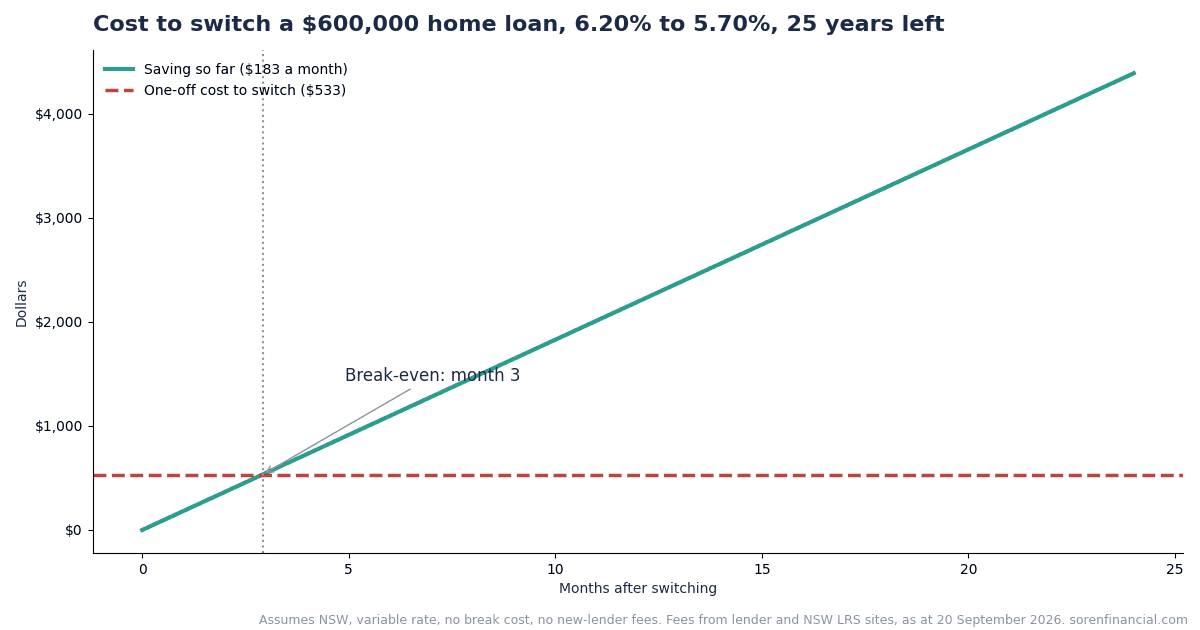
Worked example: a $600,000 loan with 25 years left, moving from 6.20% to 5.70%. Current repayment about $3,939 a month, new repayment about $3,757, so the saving is about $183 a month. Cost to switch on a variable loan in NSW: a $350 discharge fee plus the $182.73 government fee, which is $532.73. That pays for itself in 3 months, and after five years you are roughly $10,445 ahead. Add a $4,000 break cost and the same switch takes about 25 months to break even.
Where the fee numbers come from
- Discharge fee: Westpac, NAB, CommBank and St George each charge $350; ANZ charges three separate $160 fees; Macquarie charges $400; HSBC $395. Sources and dates are on each lender page in our discharge forms guide.
- Government fee: NSW Land Registry Services charges $182.73 (including GST) to register a discharge of mortgage from 1 July 2026 (NSW LRS fee schedule). Victoria, Queensland and the other states set their own.
- Break cost: only your bank can tell you this, it changes daily with market rates, and the quote is usually valid for five to seven days. Get it in writing before you sign anything with the new lender.
- New lender fees: many lenders waive application and valuation fees on a refinance, some do not. Ask, and put the real figure in.
Three things the number will not tell you
Whether you will actually be approved. The new lender assesses you fresh: income, expenses, other debts, and whether the property values up. A rate you cannot get approved for is not a saving. Our borrowing power calculator gives a rough read before you commit.
What your offset was doing for you. If your current loan has an offset account with money in it, part of your interest bill is already being cut. Compare like with like, and before the old bank closes the account, check the offset was being credited properly.
Whether waiting beats switching. On a fixed rate with a big break cost, the answer is sometimes to wait until the fixed term ends and switch then. Put the break cost in the calculator, look at the break-even, and if it is past two years, run the numbers again with a break cost of zero and the date the fixed term ends.
Refinancing? We do the switching for you
When Soren Financial refinances a client, we run these numbers properly against the lenders on our panel, get the break-cost quote from your bank, prepare and lodge the discharge form, and line the old loan's payout up with the new loan's settlement so you are not paying two loans or none. The incoming lender pays us. You get one person to ring.

Built by Mansour Soltani, Director, Soren Financial. Mansour has arranged refinances across the major banks and the non-bank lenders since 2019. Certificate IV and Diploma in Finance and Mortgage Broking Management. FBAA member. Credit Representative 527161 of Finsure Finance and Insurance Pty Ltd, Australian Credit Licence 384704.
Frequently asked questions
How much does it cost to refinance a home loan?
On a variable loan in NSW, usually the old bank's discharge fee ($350 at most majors) plus the $182.73 government fee, so a little over $500, plus whatever the new lender charges. On a fixed loan, add the break cost, which can be anything from a few hundred dollars to tens of thousands.
Is it worth refinancing for a 0.5% lower rate?
On a $600,000 loan with 25 years left, half a percent is about $183 a month, or around $2,196 a year. Against a switching cost of a few hundred dollars that pays back inside a year. Against a large break cost it may not. Put your own numbers in above.
Does the calculator include lenders mortgage insurance?
No. If your loan is above 80% of the property's value, the new lender may charge lenders mortgage insurance again, and that can be thousands. If you think you are near 80%, talk to us before you rely on the number.
Why does the break cost matter so much?
Because it is the one cost that can be larger than a year or two of savings. It is the bank's estimate of what it loses when you leave a fixed rate early, it moves with market rates, and it can only be confirmed a few days before settlement.
Can a broker get the discharge fee waived?
Rarely. The discharge fee is set by the bank you are leaving. What a broker can do is compare the whole cost against the whole saving across many lenders, and sometimes find a cashback or fee waiver from the new lender that covers it.