
Bank of Melbourne Discharge Form: How to Discharge Your Home Loan
Quick answer. The Bank of Melbourne discharge form comes two ways: an online Property and Security Request form, or a PDF called Request to Amend an Existing Security that you download, print and sign. Oddly, a full discharge is emailed to nswdischarges@stgeorge.com.au, because Bank of Melbourne and St George are the same bank. It charges a $350 loan discharge fee per loan account and a $100 document processing fee, plus the NSW government’s $182.73 (Victoria’s fee differs) to register the discharge, and asks for the form at least ten business days before settlement. A broker refinancing you handles this.
Looking for the Bank of Melbourne discharge authority form? It’s the same document this page covers. “Discharge authority” and “discharge form” are two names for the paperwork that tells Bank of Melbourne to release its mortgage over your property.
Where to get the official Bank of Melbourne discharge form
Start at Bank of Melbourne’s how to discharge your mortgage page. From there you can use the online Property and Security Request form or download the Request to Amend an Existing Security (PDF). Format: your choice of online or PDF. All parties to the loan, including guarantors, must sign the PDF.
Where it goes depends on what you are doing. A full discharge is emailed to nswdischarges@stgeorge.com.au, which is printed on Bank of Melbourne’s own form; a partial discharge or swap of security goes to mortgagesecurityvariations@bankofmelbourne.com.au. Post goes to Bank of Melbourne, Mortgage Discharges, Locked Bag 1, Kogarah NSW 1485. Phone is 1300 999 266, option 2. If the St George address looks wrong, it is not: Bank of Melbourne, BankSA and St George are one bank with three names, and our St George page describes the same form.
What you’ll need to fill it in
- Whether you want a full discharge, a partial discharge or a substitution of security.
- Loan account numbers, the names on each, a phone number, email and postal address.
- Your solicitor or conveyancer, or the other financial institution if refinancing, with their contact details.
- The property being released: address, title reference, sale price if selling, and your anticipated settlement date.
- What to do with each loan at settlement: close it, convert to a savings account, or reduce the limit; and where surplus funds go.
- Supporting documents if you are signing as an executor or under a power of attorney.
- Signatures from every party to the loan, including any guarantor.
What it costs
| Cost | Amount | Source |
|---|---|---|
| Bank of Melbourne loan discharge fee | $350 per loan account (as at 20 September 2026) | Bank of Melbourne home loan charges, 22 April 2025 |
| Bank of Melbourne document processing fee | $100 (as at 20 September 2026) | Bank of Melbourne home loan charges, 22 April 2025 |
| Fixed-rate break cost | Individually calculated | Bank of Melbourne home loan charges |
| Victorian government fee to register the discharge | Set by Land Use Victoria; check the current schedule | Land Use Victoria 2026-27 fees |
| NSW government fee to register the discharge | $182.73 incl. GST (as at 20 September 2026; other states differ) | NSW LRS 2026/27 fees |
The $350 is per loan account, so two splits means two fees. Bank of Melbourne’s fees page also notes that its introductory-rate loans carry an early termination fee worked out as a percentage of the loan if you leave inside a set period, so check which product you have.
On a fixed rate, the break cost is the number to get first. Bank of Melbourne charges it if you pay out the loan, overpay past the threshold, or switch products before the fixed period ends, and it is an individual calculation.
How long it takes
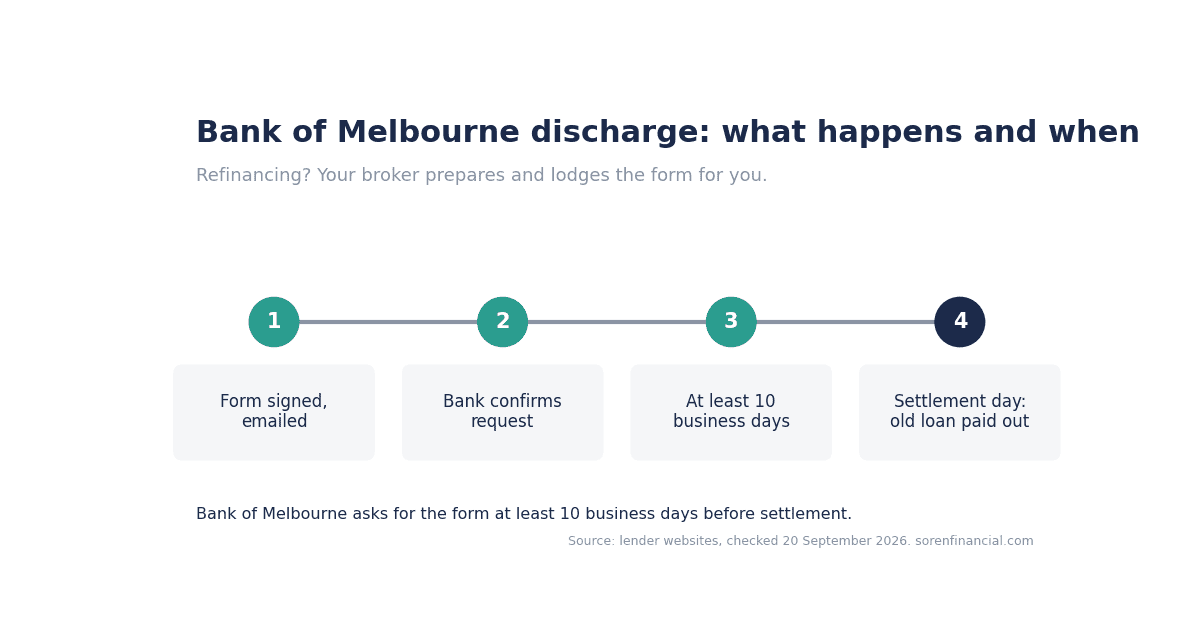
The form says to lodge it at least ten business days, which the bank spells out as 14 calendar days excluding public holidays, before settlement. Bank of Melbourne does not publish a processing time beyond that, so treat ten business days as the floor and check with the bank on your file.
What slows it down is a title reference that does not match, a missing guarantor signature, or a full discharge sent to the partial-discharge mailbox. Use the right address.
The traps we see people fall into
The wrong mailbox. Full discharge to the St George address, partial to the Bank of Melbourne one. Send it to the wrong place and it can sit. The form tells you which; read the top of it.
Lodging before the new loan is unconditional. The form instructs the bank to release its mortgage. If the incoming lender has not given unconditional approval, wait.
The offset balance. The form’s authority section says you authorise the bank to cancel all facilities linked to the loan, offset included. Decide where that money goes, and before the account closes, check the offset was being credited. How to check.
Timing. The old loan has to be paid out the day the new one settles. Someone has to own that date. When we refinance a client, we do.
Run the numbers before you send the form
A discharge only makes sense if the new loan beats the old one after the fees. Our calculators do the maths in a minute or two:
- Cost to switch calculator — the one to start with: it takes the discharge fee, the government fee and any break cost and tells you how many months until the switch has paid for itself.
- Loan repayment calculator — the new lender’s rate next to what Bank of Melbourne charges you now.
- Home loan offset calculator — what an offset account is worth to you, at either lender.
- Offset account checker — before the old loan closes, check Bank of Melbourne was crediting your offset properly. It is much harder to argue a mistake after the account is gone.
Refinancing? You don’t need to do any of this yourself
When Soren Financial refinances a client away from Bank of Melbourne, we prepare the Request to Amend an Existing Security, tell you exactly where to sign, lodge it, chase the payout figure and any break cost, and book settlement so the Bank of Melbourne loan closes the day the new one opens. The incoming lender pays us, so it costs you nothing.

Written by Mansour Soltani, Director, Soren Financial. Mansour has arranged refinances across the major banks and the non-bank lenders since 2019, and handles the discharge paperwork for every client Soren moves. Certificate IV and Diploma in Finance and Mortgage Broking Management. FBAA member. Credit Representative 527161 of Finsure Finance and Insurance Pty Ltd, Australian Credit Licence 384704.
Frequently asked questions
Why does the Bank of Melbourne discharge form have a St George email address?
Because Bank of Melbourne and St George are the same bank under different names. Full discharges go to nswdischarges@stgeorge.com.au; partial discharges go to mortgagesecurityvariations@bankofmelbourne.com.au.
How much is the Bank of Melbourne discharge fee?
$350 per loan account plus a $100 document processing fee, as at 20 September 2026. Government registration fees and any break cost are extra.
How long does a Bank of Melbourne discharge take?
Lodge the form at least ten business days (14 calendar days) before settlement. The bank does not publish a processing time beyond that.
Is there an online Bank of Melbourne discharge form?
Yes, the Property and Security Request form at psr.bankofmelbourne.com.au, or you can use the PDF.
Do all borrowers have to sign?
Yes, every party to the loan including any guarantor. Executors and attorneys need to attach their supporting documents.
Is the Bank of Melbourne discharge authority the same as the discharge form?
Yes, they are the same thing. People call it a discharge authority because signing it authorises Bank of Melbourne to release the mortgage. If you are refinancing with us, we fill it in and lodge it for you.