
ING Discharge Form: How to Discharge Your Home Loan
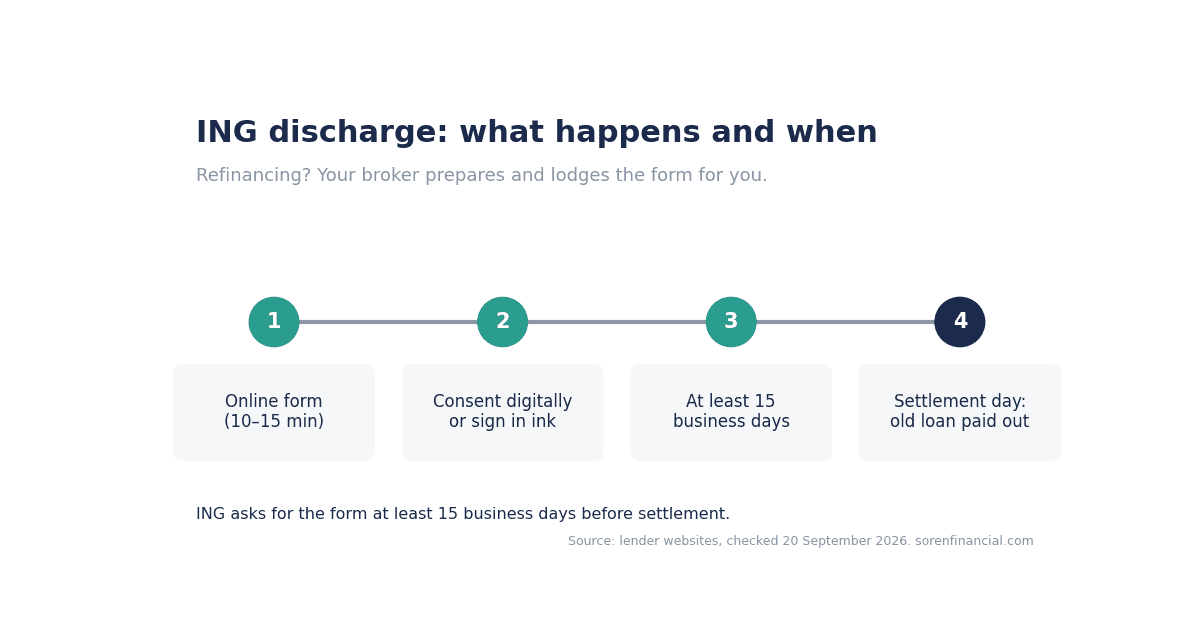
Quick answer. The ING discharge form is an online form called the Mortgage Discharge Request. You fill it in on ING’s website (it takes 10 to 15 minutes and cannot be saved part way), then either give consent digitally or print it and sign in ink, and email it to mortgage.discharges.au@ing.com from the email address ING has on file. ING asks for the form at least 15 business days before settlement. ING’s exact discharge fee is not on its public pages; ING says these fees are typically a few hundred dollars, so check with the bank. The NSW government fee to register the discharge is $182.73. A broker refinancing you does all of this for you.
Searching for the ING discharge authority? You’re in the right place. A discharge authority and a discharge form are the same thing: your signed instruction for ING to release the mortgage on your property.
Where to get the official ING discharge form
ING lists it on its home loan forms page as “Mortgage Discharge Request”, which takes you to the online discharge form. Format: online. ING has retired the old IM128 paper form; copies on document sites are out of date. Allow 10 to 15 minutes, and note ING’s warning that you cannot save progress, so have your loan numbers in front of you.
At the end you choose: tick the box to consent digitally, or print, sign in ink, scan and email. If your loan is set up as “all to operate”, ING requires every borrower’s ink signature. Either way the form goes to mortgage.discharges.au@ing.com, and ING asks that it come from the email address registered on your account so it can verify you. Existing home loan customers can call 133 464.
What you’ll need to fill it in
- Who is completing the form: borrower, broker, solicitor, executor or guarantor.
- Why you are discharging: refinancing (and to which lender), sale (and the sale price), or paying out with your own money.
- Borrower and guarantor names (up to four) and a company name if one is on the loan.
- Every loan account number to be discharged; the form takes up to eight.
- Your main contact for the discharge: you, the incoming lender, or your solicitor or conveyancer, with their details.
- The property address and your estimated settlement date; whether you need a Section 27 (Victoria only).
- The account for any leftover money (name, BSB, account number) and a post-settlement address if it is changing.
- Digital consent, or ink signatures from all borrowers if the loan is all-to-operate.
What it costs
| Cost | Amount | Source |
|---|---|---|
| ING discharge / settlement fee | Not shown on ING’s public pages; ING says “typically cost a few hundred dollars” — check with the bank | ING: what costs to expect when selling your home |
| Fixed-rate break cost | Individually calculated from the remaining fixed term and ING’s change in cost of funds | ING home loan terms and conditions, clause 2.2 |
| NSW government fee to register the discharge | $182.73 incl. GST (as at 20 September 2026; other states differ) | NSW LRS 2026/27 fees |
ING’s fee sheets sit behind a login-style page and its FAQ on the discharge fee loads in a way we could not verify live, so we have not printed a number. ING’s own article says a discharge or settlement fee applies on both variable and fixed loans and that these fees are typically a few hundred dollars. Your loan offer and fee schedule state the exact amount; ask ING when you lodge.
If you are on a fixed rate, ING’s break cost is worked out from the principal left, the time left on the fixed period, and how ING’s cost of funds has moved since you fixed. It can be small or large depending on where rates have gone. Get the figure before you commit to the new lender.
How long it takes
ING’s instruction is to return the form at least 15 business days before your planned settlement date, which is longer than the ten most of the majors ask for. Its older guidance said a full discharge needs a minimum of ten days and a partial discharge about three weeks. Plan on three weeks.
The delay we see most with ING is the email check: send the form from an address ING does not have on file and it can sit unactioned. Use the one on your ING account, or have your broker lodge it.
The traps we see people fall into
Losing the form halfway. ING’s online form cannot be saved. Close the tab and you start again. Gather loan numbers, the new lender’s details and your settlement date before you open it.
Lodging before the new loan is unconditional. Fifteen business days feels like a lot of lead time, so people lodge early to be safe, before the new lender has actually approved them. If the approval falls over, you have told ING you are leaving for nothing. Unconditional approval first.
The offset balance. ING’s Orange Advantage loans usually carry an offset, and at settlement ING clears the loan and closes the linked accounts. Decide where that balance goes, and before it shuts, check the offset was being credited properly. How to check.
Two loans, or none. The old loan has to be paid out the day the new one settles. With ING’s longer lead time, the incoming lender is often ready first. Somebody has to hold both to the same date. When we refinance a client, we do.
Run the numbers before you send the form
A discharge only makes sense if the new loan beats the old one after the fees. Our calculators do the maths in a minute or two:
- Cost to switch calculator — the one to start with: it takes the discharge fee, the government fee and any break cost and tells you how many months until the switch has paid for itself.
- Loan repayment calculator — the new lender’s rate next to what ING charges you now.
- Home loan offset calculator — what an offset account is worth to you, at either lender.
- Offset account checker — before the old loan closes, check ING was crediting your offset properly. It is much harder to argue a mistake after the account is gone.
Refinancing? You don’t need to do any of this yourself
When Soren Financial refinances a client away from ING, we prepare the Mortgage Discharge Request, tell you exactly where to sign, lodge it, chase the payout figure and any break cost, and book settlement so the ING loan closes the day the new one opens. The incoming lender pays us, so it costs you nothing.

Written by Mansour Soltani, Director, Soren Financial. Mansour has arranged refinances across the major banks and the non-bank lenders since 2019, and handles the discharge paperwork for every client Soren moves. Certificate IV and Diploma in Finance and Mortgage Broking Management. FBAA member. Credit Representative 527161 of Finsure Finance and Insurance Pty Ltd, Australian Credit Licence 384704.
Frequently asked questions
Is there an ING discharge form PDF?
Not any more. ING uses an online Mortgage Discharge Request. The old IM128 PDFs on document sites are out of date.
How much is the ING discharge fee?
ING does not print the figure on its public pages. ING says discharge or settlement fees typically cost a few hundred dollars; your loan offer and fee schedule state the exact amount. Check with the bank.
How long does an ING discharge take?
ING asks for the form at least 15 business days before settlement. Plan on three weeks.
Where do I send the ING discharge form?
Email it to mortgage.discharges.au@ing.com from the email address registered on your ING account.
Can I sign the ING discharge form electronically?
Usually yes: the online form lets you tick a box to consent digitally. If your loan is all-to-operate, ING requires every borrower’s ink signature instead.
Is the ING discharge authority the same as the discharge form?
Yes, they are the same thing. People call it a discharge authority because signing it authorises ING to release the mortgage. If you are refinancing with us, we fill it in and lodge it for you.