
ASIC just confirmed something I’ve been finding in client files for years. Eight banks. 204,000 home loans reviewed. More than $55 million already paid back to customers because their mortgage offset accounts weren’t doing what the bank said they’d do.
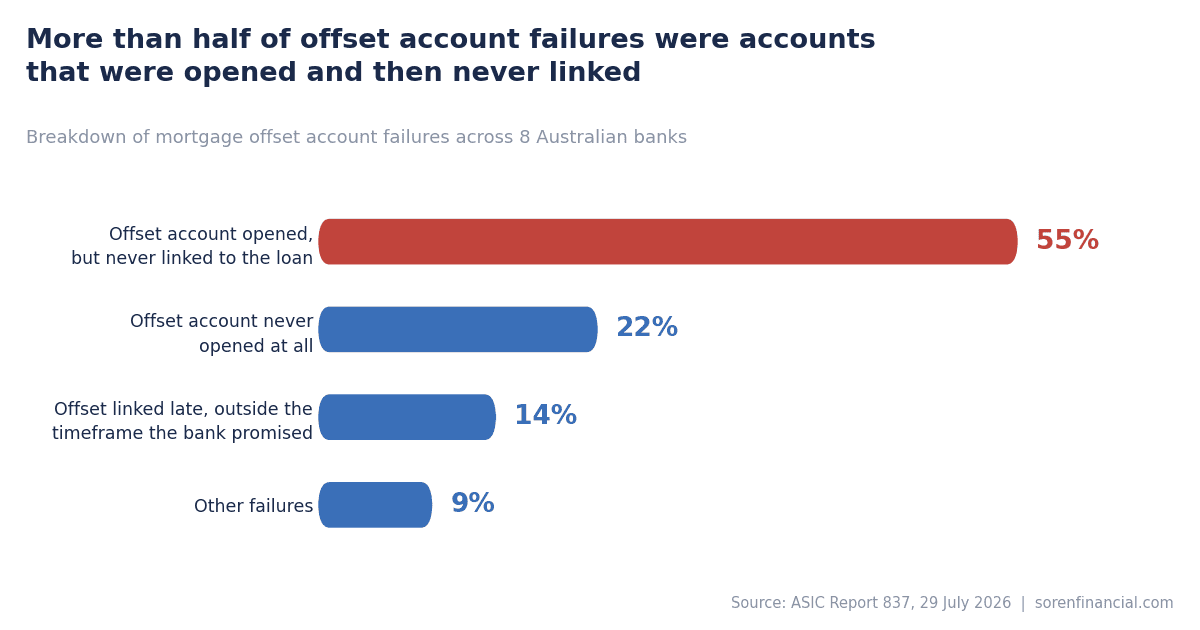
The most common failure? The offset account was opened and then never linked to the loan. That was 55% of the cases. Not a pricing dispute, not a fine print argument. The account existed, the money sat in it, and the loan never knew about it.
If you want to know how to check if your offset account is working, this post gives you the two things you need: where to look in your banking, and the calculation to sense check it yourself so you’re not just taking the bank’s word for it.
Want us to run these numbers over your loan? Email startnow@sorenfinancial.com with your latest statement and we’ll tell you whether your offset is actually pulling its weight.
Prefer to look before you talk to anyone? Answer nine quick questions and see roughly what you could borrow.
What ASIC actually found
The report is REP 837, released 29 July 2026, and it’s called Offsets, out of mind: Banks fall short on mortgage offset account promises. ASIC looked at AMP Bank, ANZ, Commonwealth Bank, Great Southern Bank (Credit Union Australia), HSBC Australia, ING, Macquarie and Westpac. Between them that’s over 70% of Australia’s $2.5 trillion home loan market.
The breakdown of failures:
- 55%: offset account opened, but never linked to the loan
- 22%: offset account never opened at all
- 14%: offset linked, but later than the bank said it would be
- 9%: everything else
86% of the documented failures came down to manual staff error. Someone didn’t tick the box.
ASIC Chair Sarah Court put it about as bluntly as a regulator can: “When offset accounts don’t operate correctly, the harm can be hidden. Loan repayments stay the same, while customers unknowingly pay more interest.” She also said “in some cases, offset failures went undetected until ASIC started asking questions. That should concern every bank.”
One customer got repaid over $17,000. Another paid an extra $3,500 in interest in just over a month because the offset link broke.
There’s $349.1 billion sitting in Australian offset accounts as at March 2026. You do the maths on what a small error rate across that pile is worth.
Why you’d never notice on your own
This is the part that makes it dangerous, and it’s the reason a 55% “never linked” rate can hide for years.
Your minimum repayment does not change when your offset stops working.
Your repayment was set when the loan settled, based on the balance and the remaining term. If $50,000 disappears from your offset calculation, the bank doesn’t send you a bigger bill. It just quietly takes a bigger slice of your existing repayment as interest and a smaller slice off the principal. Same money out of your account every month. Less of it going where you thought it was going.
So there’s no red flag. No letter. Nothing bounces. You just end up years down the track with a higher balance than you should have, and no obvious reason why.
The only way you catch it is by looking.
How to check if your offset account is working, in about five minutes
Do these in order. Most people find the answer at step 2 or 3.
1. Confirm the account is actually an offset account. Log into your banking and look at the account name and product type. An offset should be labelled as one, or sit under the home loan in the account list. A plain everyday transaction account or savings account with money in it is not an offset, no matter how it’s being used. I’ve had clients who were “offsetting” into a bonus saver for two years.
2. Find the link, in writing, inside your banking. On most lenders the loan account screen shows the linked offset account number, or the offset screen shows which loan it’s attached to. Screenshot it. If your banking doesn’t show a link anywhere, that’s not proof it’s broken, but it means you have to do step 4.
3. Check your loan statement for the offset balance. Good statements show either the offset balance or a “balance interest is calculated on”. If the interest is being calculated on your full loan balance while there’s money sitting in the offset, you’ve found your problem.
4. Run the calculation. This is the one that can’t be argued with, and it’s in the next section. If you’d rather not do it by hand, our Offset Connection Calculator does it for you.
5. Ask the bank a specific question. Not “is my offset working”. Ask: “Please confirm in writing which account is linked as an offset to loan number X, the date that link was established, and the offset balance used in the interest calculation for the last full month.” A vague question gets a vague answer. A specific one creates a record.
The calculation to sense check your offset account
Australian home loan interest is calculated daily and charged monthly. The formula is not complicated.
Daily interest = (loan balance − offset balance) × annual interest rate ÷ 365
Then multiply by the number of days in the month to get roughly what should have been charged.
So the sense check is: work out what the interest should be with the offset counted, work out what it would be without the offset counted, and see which number the bank actually charged you.
Prefer to look before you talk to anyone? Answer nine quick questions and see roughly what you could borrow.
A worked example
Say you’ve got a $700,000 loan at 5.89%, with $50,000 sitting in the offset, over a 31 day month. Use your own rate, not mine.
If the offset is working:
$700,000 − $50,000 = $650,000
$650,000 × 5.89% = $38,285 per year
$38,285 ÷ 365 = $104.89 per day
$104.89 × 31 days = $3,251.60 in interest
If the offset is not linked:
$700,000 × 5.89% = $41,230 per year
$41,230 ÷ 365 = $112.96 per day
$112.96 × 31 days = $3,501.73 in interest
The gap is $250.12 for the month. Around $2,945 a year, which is just your offset balance times your rate.
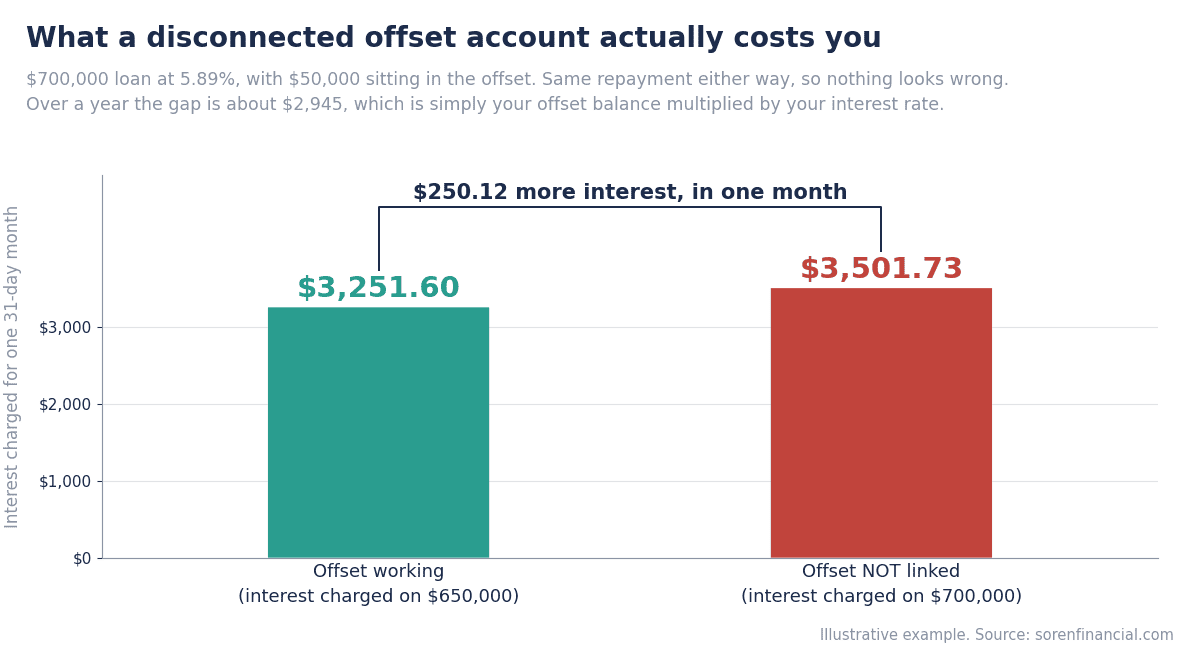
Now pull up the interest line on your last statement. If it’s sitting near $3,251, you’re fine. If it’s near $3,501, your $50,000 is doing absolutely nothing and you need to make a phone call today.
A couple of things that will throw the number out by a few dollars, so don’t panic over small differences: your loan balance and offset balance both move during the month, so the real figure is a daily average rather than a single snapshot. Some lenders use 365 days even in a leap year. And if your rate changed mid-month, the calculation splits at the change date. You’re looking for a gap of hundreds, not cents. If you’d rather not do it by hand, the Offset Connection Calculator runs both sides of this comparison for you and will get you close enough to spot a problem, and the rest of our calculators are here.
The faster version of the same test
If you don’t want to touch a calculator at all: your offset balance × your interest rate ÷ 365 = the dollars per day your offset should be saving you.
$50,000 at 5.89% is $8.07 a day. Move $10,000 out of the offset for a week, and your interest charge for that month should go up by about $11.30. If it doesn’t move at all, the offset isn’t connected.
What makes an offset account quietly stop working
The link is rarely broken from day one and then left alone. It usually breaks at a moment when you’re distracted by something bigger. Watch for these:
- Refinancing or a product switch. New loan account number, and the offset has to be re-linked to it. This is the big one.
- Rolling off a fixed rate. Some lenders create a new account number when the fixed period ends. Also worth knowing that many fixed rate loans don’t allow a 100% offset at all.
- Splitting a loan. If you split into two or three accounts, the offset attaches to one of them. Which one is a decision, and it should be the highest rate split.
- A top up or increase. Same story, sometimes a new sub-account.
- Changing the loan from owner occupied to investment, or the other way around.
- Closing or replacing the offset account itself. New card, new account, old link dies.
- Anything triggered by separation, a name change, or a deceased estate. These get processed manually, and manual is where 86% of the errors happened.
My rule with clients is simple. Any time your loan account number changes for any reason, you re-run the calculation above the following month. Not eventually. The following month.
The traps that aren’t bank errors
Before you go in hot, check that what you’re seeing isn’t just how the product works. These come up constantly:
Partial offset. Not every offset is 100%. Some products only offset a portion of your balance, or only offset up to a capped amount. Older loans and some basic products are the usual culprits.
Fixed portions. If your loan is part fixed and part variable, the offset generally only works against the variable split. Money offsetting a fixed portion often does nothing by design.
One offset, multiple loans. Most lenders let you link one offset account to one loan account. If you’ve got three splits and one offset, two of them aren’t being offset. That’s not an error, it’s a setup decision that was probably made by whoever was quickest at settlement rather than whoever was thinking about your interest bill.
Interest in advance investment loans. Different animal, and offsets usually don’t apply the way you’d expect.
Balances the bank excludes. A few products exclude pending or uncleared funds from the offset calculation.
If you’re not sure which of these applies, the answer is in your loan contract under the offset or interest calculation clause. Not in the marketing page.
What to do if your offset account isn’t linked
Don’t accept a verbal “we’ve fixed it now”. The fix and the money owed are two different conversations.
- Put it in writing to the bank and use the word “complaint”. That starts their internal dispute resolution clock, which is 30 days for most credit complaints.
- Ask for the interest to be recalculated from the date the link should have started, not from the date you noticed. ASIC’s whole point in REP 837 is that customers lost interest savings they were promised.
- Ask for the money to be credited off your loan balance, and ask what happens to the extra interest you paid on the extra interest.
- If they say no, or go quiet past 30 days, go to AFCA. It’s free. afca.org.au. They handle this exact category of complaint.
- Keep every screenshot. The bank’s system records are the evidence, and banks have been known to be slow producing them.
If a lender has already contacted you about an offset remediation, take the recalculation seriously rather than assuming it’s right. Check their number against your own using the formula above.
The thing that gets me about this one isn’t the $55 million, it’s that not a single customer found it themselves. They couldn’t. Your repayment doesn’t change, so the only person who could have caught it was the bank, and they waited until ASIC asked. Check your own numbers, because nobody else is going to.
Mansour Soltani, Soren Financial
Shameless plug
If you’re a client of ours, we already check this at settlement and again whenever your loan structure changes, because I’ve seen how expensive the alternative is.
If you’re not, and you’ve refinanced, split a loan, rolled off a fixed rate or changed a loan purpose in the last few years, spend the five minutes. Worst case you confirm everything is fine. Best case you find a few thousand dollars that’s yours.
For where rates are heading and what that does to the value of your offset balance, the OurTop10 Rate Index (ORPI) is updated after every RBA meeting.
Want a second set of eyes on your loan structure? Email startnow@sorenfinancial.com and we’ll check whether your offset is linked, whether it’s linked to the right split, and what it should be saving you.
Prefer to look before you talk to anyone? Answer nine quick questions and see roughly what you could borrow.
General information only. This isn’t financial or credit advice and it doesn’t take your situation into account. Numbers used are examples, and your loan terms, rate and product features will change the result.
About the author

Mansour Soltani
Director, Soren Financial
Mansour leads Soren Financial, working with clients across home loans, refinancing and property investment. A regular media contributor to ABC, Domain and Australian Broker, he holds a Certificate IV and Diploma in Finance and Mortgage Broking.
View full profile →