
Offset VS Redraw Which is better ?
This is a question that as mortgage brokers in Sydney we get asked all the time by home buyers, so I thought I would break down how they work, the differences and I will dispel some myths around offset and redraw accounts.
The short version:
An offset account is a transaction account linked to your home loan, reducing the balance on which interest is charged and thereby saving you interest. In contrast, a redraw facility allows you to access extra payments you’ve made on your home loan.
Offset accounts and redraw facilities both lower the amount of interest you pay on your home loan by reducing the balance.
With a redraw facility, you save on interest directly, as the extra payments you’ve made (and can withdraw if needed) decrease your loan balance. An offset account, on the other hand, indirectly saves you interest because the lender calculates your home loan interest based on the loan balance minus the balance in your offset account.
Not sure which one your loan should have? Email startnow@sorenfinancial.com and we’ll run your numbers and tell you straight.
What is an offset account?
We always recommend saving money to our clients, I know this is a pretty basic piece of advice, however you will be surprised how many people we come across who live pay cheque to pay cheque or they are not planning for their future.
So how does an offset help with this? Well if you have a home loan or are planning to get a mortgage, an offset is the best savings account you will ever have.
Whilst most people are focussed on high interest accounts which usually pay you a measly amount (especially these days) and have to pay tax on, an offset saves you from interest which I admit does not sound as sexy as earning money but I can tell you it is more powerful and I will show you why.
To explain the true value of an offset account and its compounding effects we need to show you in the form of a graph. The two graphs below were produced in June 2024 at a 5.50% rate; the figures in the text and the results table have been updated to the current rate of 6.19% (RBA Table F6, July 2026), which makes the offset worth even more.
Take a look at what happens when you save up 5% of your loan amount ($40,000 on an $800,000 loan) and place it in your offset account under this scenario: congratulations, you just cut over three years off your 30 year loan, great start!
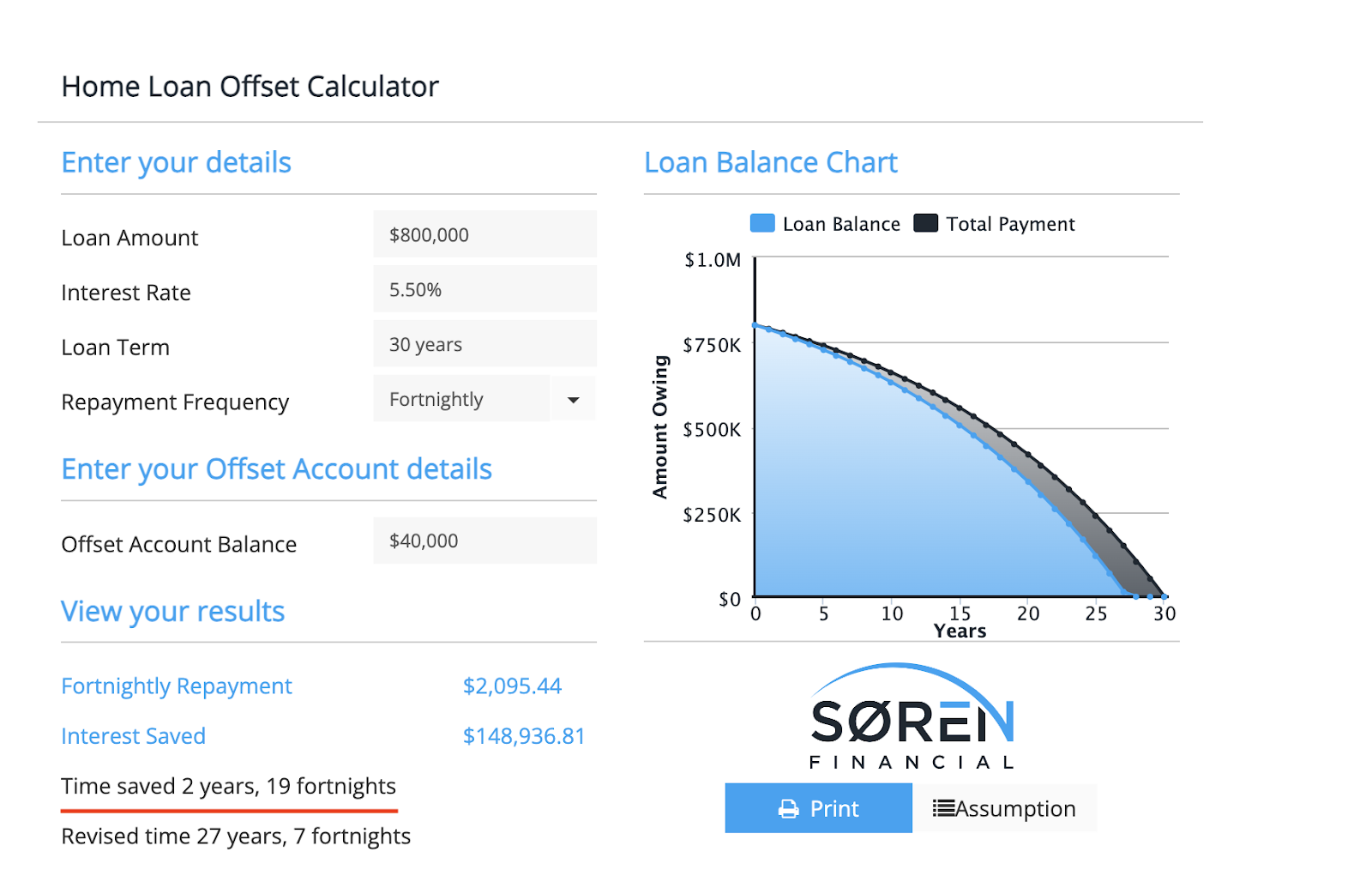
Now look what happens when you save up 10% of the loan amount ($80,000): you shave over five and a half years off your home loan. Now think about your situation and what cutting this length of time off your home loan is going to do for your life and the life of your family.
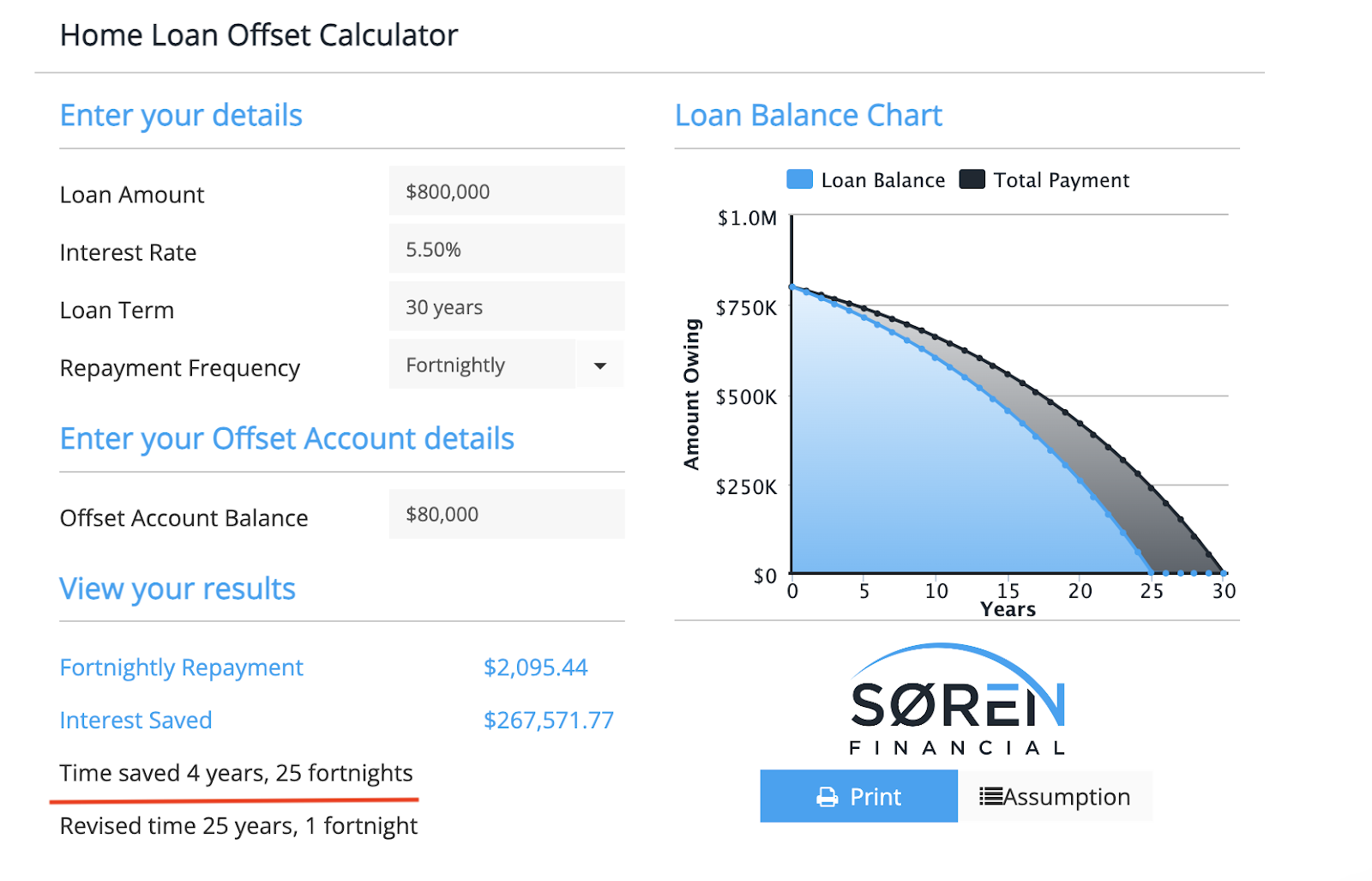
This scenario demonstrates the impact of an $80,000 offset account balance on an $800,000 home loan at today’s rate. Here’s a detailed analysis:
Loan and Offset Details:
- Loan Amount: $800,000
- Interest Rate: 6.19% (RBA Table F6, July 2026, average variable rate on outstanding owner-occupier principal-and-interest loans)
- Loan Term: 30 years
- Repayment Frequency: Fortnightly
- Offset Account Balance: $80,000 (held constant)
Results:
- Fortnightly Repayment: $2,259.03
- Interest Saved: $328,585
- Time Saved: 5 years and 15 fortnights
- Revised Loan Term: 24 years and 10 fortnights
The amount of money that you save in interest is over $320k however shaving five and a half years off the loan and the investment opportunities this allows you so you can secure your financial future is huge! (Figures calculated September 2026. Your lender’s calculator may use a slightly different fortnightly method.)
Here are some graph insights:
- Loan Balance: The blue area represents the loan balance over time without an offset account.
- Total Payment: The black line indicates the total payment over time.
- Impact of Offset: With the offset account, the loan balance decreases faster due to the interest savings, as evidenced by the steeper decline of the blue area compared to the black line.
Redraw accounts:
Redraw accounts have the same main advantage that offset accounts have which is they will reduce your overall interest bill. The redraw is there to give you the ability to make extra payments and access those payments whenever you need it.
Redraw accounts are traditionally free with your home loan and the extra funds are meant to be easily accessible (make sure you check this with your lender or mortgage broker before you sign your loan documentation).
We generally tell clients that a redraw account is best for owner occupiers and offset accounts are best for investment property loans unless they specifically request otherwise.
Mansour Soltani – Finance Broker
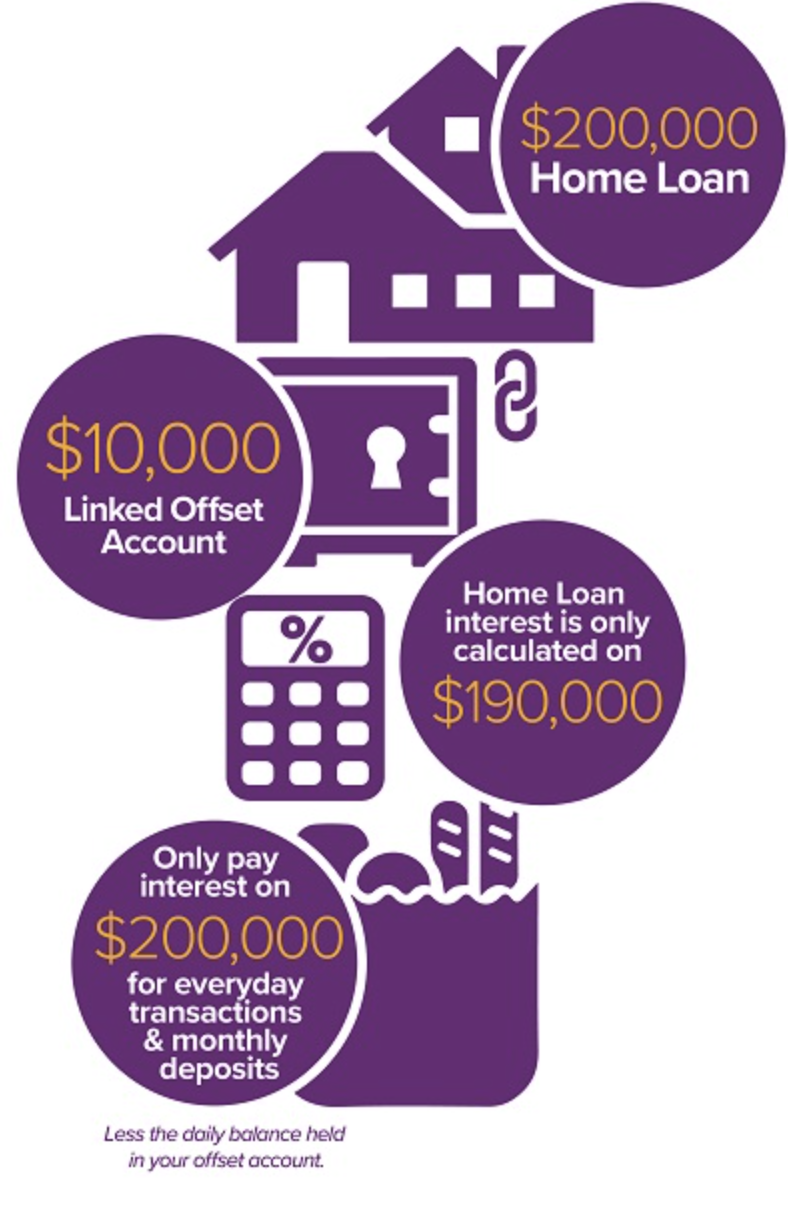
A summary of the difference
Offset Account
An offset account is a transaction account linked to your home loan. The balance in this account offsets the balance in your home loan, reducing the interest you pay.
Redraw Account
A redraw facility allows you to make extra payments on your home loan and access those extra funds if needed.
Differences
- Offset Account: Reduces the loan balance daily with the offset balance.
- Redraw Account: Allows withdrawal of extra repayments made.
FAQs
1. What is an offset account?
- An offset account is a transaction account linked to your home loan. The balance in this account reduces the amount of your home loan on which interest is calculated, thus saving you interest over time.
2. How does an offset account help save on interest?
- The lender calculates your home loan interest based on the loan balance minus the balance in your offset account. This means the more money you keep in your offset account, the less interest you pay.
3. What is a redraw facility?
- A redraw facility allows you to make extra payments on your home loan and withdraw those extra funds if needed. It helps in reducing the principal amount of your loan, thereby saving on interest.
4. How does a redraw facility save on interest?
- By making extra payments, you directly reduce your loan balance. The interest is then calculated on this lower balance, resulting in interest savings. You also have the flexibility to access these extra payments if needed.
5. Which is better, an offset account or a redraw facility?
- Both offset accounts and redraw facilities help reduce the interest you pay on your home loan. The choice depends on your financial situation and preferences. An offset account provides easier access to your funds, while a redraw facility requires you to make extra payments that you can withdraw later.
6. Can I have both an offset account and a redraw facility?
- Yes, some lenders offer both options on the same home loan. This allows you to enjoy the benefits of both features simultaneously however please check what the associated costs are.
7. Are there any tax implications with an offset account?
- Unlike interest earned on savings accounts, the interest savings from an offset account are not considered taxable income, which can be a tax-efficient way to reduce your home loan interest.
8. Are there fees associated with using an offset account or redraw facility?
- Some lenders may charge fees for maintaining an offset account or using a redraw facility. It’s important to check with your lender about any potential fees.
9. How much can I save with an offset account?
- The savings depend on the balance maintained in the offset account. For instance, maintaining an $80,000 balance in an offset account linked to an $800,000 home loan at 6.19% (the RBA’s July 2026 average variable owner-occupier principal-and-interest rate) could save you approximately $328,585 in interest and shorten your loan term by 5 years and 15 fortnights. Use our offset calculator to see how much you can save by entering your own details.
10. What should I consider when choosing between an offset account and a redraw facility?
- Consider factors such as your need for easy access to funds, potential fees, tax implications, and how each option aligns with your financial goals and habits.
Want us to check whether your loan is set up the right way round? Email startnow@sorenfinancial.com with your loan balance and rate and we’ll show you the saving.
About the author

Mansour Soltani
Director, Soren Financial
Mansour leads Soren Financial, working with clients across home loans, refinancing and property investment. A regular media contributor to ABC, Domain and Australian Broker, he holds a Certificate IV and Diploma in Finance and Mortgage Broking.
View full profile →