
Home loan cashback offers in 2026: who still pays, and is it worth it?
Remember when every lender was throwing $4,000 at you to refinance? The cashback wars of 2022-23 are well and truly over. The big banks worked out that refinancers were taking the money and leaving again, and one by one the offers disappeared — a couple of majors have even swapped cash for frequent flyer points. But home loan cashback offers have not vanished completely in 2026. A small number of lenders are still paying them, and if the loan stacks up anyway, there is no reason to leave the money on the table.
Want to know if you qualify for a cashback right now, and whether the loan behind it is actually any good? Reach out at startnow@sorenfinancial.com and we will run both numbers for you.
The home loan cashback offers we can still write in 2026
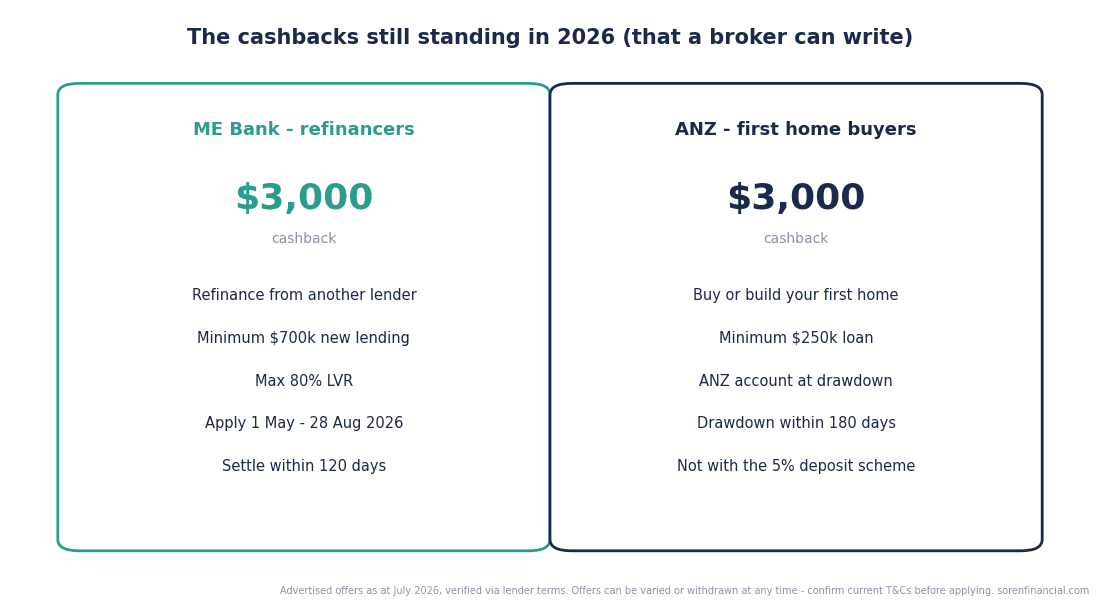
These are the home loan cashback offers available through our lender panel as at July 2026. Cashbacks get varied and withdrawn constantly, so treat this as a snapshot and check with us before you count the money:
- ME Bank — $3,000 for refinancers. Refinance an existing loan from another lender with minimum new lending of $700,000 and an LVR of 80% or less. Applications must be in between 1 May and 28 August 2026 and settle within 120 days. If your loan is under $700k, this one is not for you.
- ANZ — $3,000 for first home buyers. Buy or build your first home with an eligible ANZ loan of $250,000 or more, hold an ANZ account at drawdown, and draw down within 180 days of applying. The catch worth knowing: it is not available if your loan uses a government guarantee, so you cannot stack it with the 5% deposit First Home Guarantee. For some buyers the LMI saving from the guarantee beats the $3,000; for others with a bigger deposit, the cash wins. That is a maths problem, not a guess.
Why did cashback offers disappear?
Simple economics. When rates started climbing, lenders used cashbacks to buy refinance volume, and borrowers learned to churn: take the cash, wait out the clawback period, refinance again for the next cheque. Lenders were paying thousands to win customers who left within two years. The majors pulled their offers, and what is left today is mostly smaller lenders buying market share. Which, to be fair, can mean a genuinely sharp deal — as long as the rate stacks up on its own.
“A cashback is the lender paying you to not compare rates. Take the $3,000 if the loan is right anyway – but a rate 0.2% too high on a $600k loan eats the entire cashback in under three years.”
Mansour Soltani, Founder, Soren Financial
When is a cashback actually worth taking?
Run the maths before the money runs you. A rate just 0.20% higher on a $600,000 loan costs about $1,200 a year — so a $3,000 cashback attached to the wrong rate is fully eaten inside three years, and after that you are paying for the privilege every year you stay. The cashback is the tiebreaker, never the reason. Get the rate and structure right first, then take the cheque if one happens to be attached. Our calculators will show you what a rate difference does over the life of your loan.
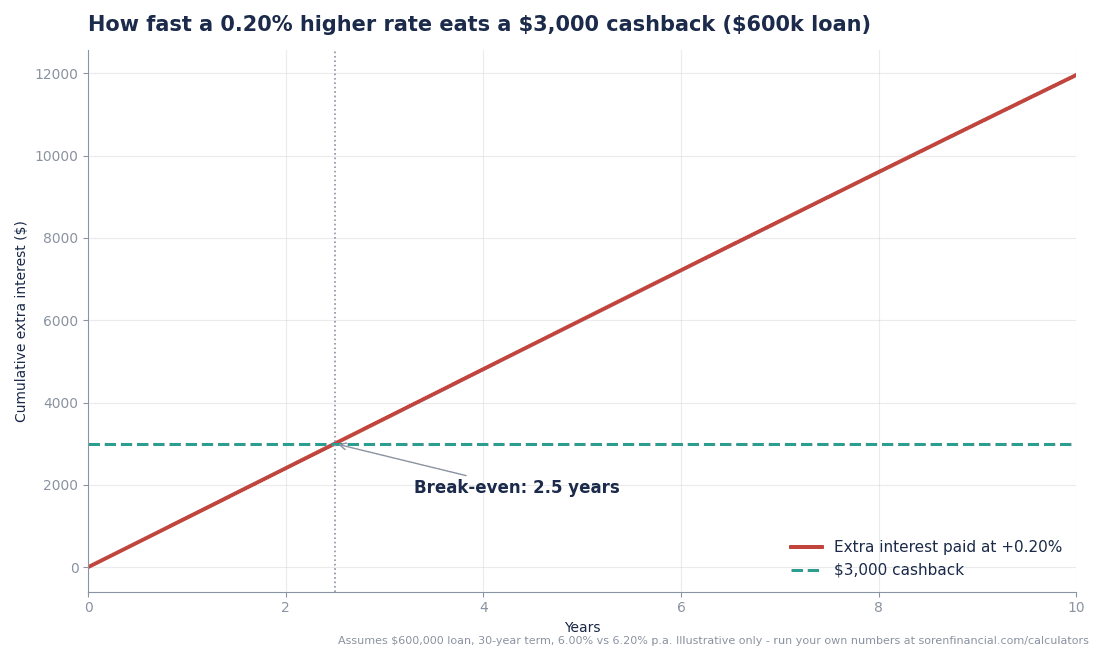
That chart is the whole argument in one picture: on a $600,000 loan, the extra interest from a rate 0.20% higher crosses the $3,000 cashback at about two and a half years. Keep the loan for the average five-plus years and the “free money” has cost you double. This is why we treat home loan cashback offers as a bonus on an already-right loan, never the reason to pick a lender — and why the best home loan cashback offers are the ones attached to a rate you would have chosen anyway.
Moral of the story: cashback offers in 2026 are rare, conditional and occasionally still worth it. If you are refinancing or buying your first home, get in touch at startnow@sorenfinancial.com and we will tell you honestly whether the cashback deal or the better rate elsewhere leaves you in front — you can also check our client reviews on OurTop10.
About the author

Mansour Soltani
Director, Soren Financial
Mansour leads Soren Financial, working with clients across home loans, refinancing and property investment. A regular media contributor to ABC, Domain and Australian Broker, he holds a Certificate IV and Diploma in Finance and Mortgage Broking.
View full profile →