
Debt recycling is the process of turning the non-deductible debt on your own home into deductible debt used to buy income-producing investments, without increasing how much you owe overall. You repay a chunk of the home loan, borrow the same amount back through a separate split, and invest it.
Written down like that it sounds like free money. It isn’t. What you’re actually doing is swapping a guaranteed saving, the interest you’d have avoided by paying down the mortgage, for an uncertain return plus a tax deduction. Sometimes that trade is worth making. Sometimes it very clearly isn’t, and the people it hurts most are usually the ones who got the loan structure right and the risk tolerance wrong.
I’m a mortgage broker, not a financial adviser, so I can’t tell you whether to do this and nothing below is a recommendation. What I can do is explain the mechanics honestly, show you the numbers, give you a calculator to run your own slice, and point out the structural mistakes I see in loan files, because those are the part that lands on my desk.

“Most of the debt recycling files that land on my desk went wrong at the loan structure, not the investment. Someone used redraw instead of a clean split, or paid a credit card out of the investment account once, and the deductibility is gone. Get the plumbing right first. It costs nothing to do properly and a lot to fix.”
Mansour Soltani, Director, Soren Financial
What debt recycling actually is
In Australia, interest is generally deductible when the borrowed money is used to produce assessable income. What matters is what you did with the funds, not what the loan is secured against. Your home loan isn’t deductible because you bought a house to live in. Borrow against the same house to buy shares that pay dividends and the interest on that borrowing generally is deductible.
Debt recycling exploits nothing more exotic than that. Same total debt, different purpose, different tax treatment.
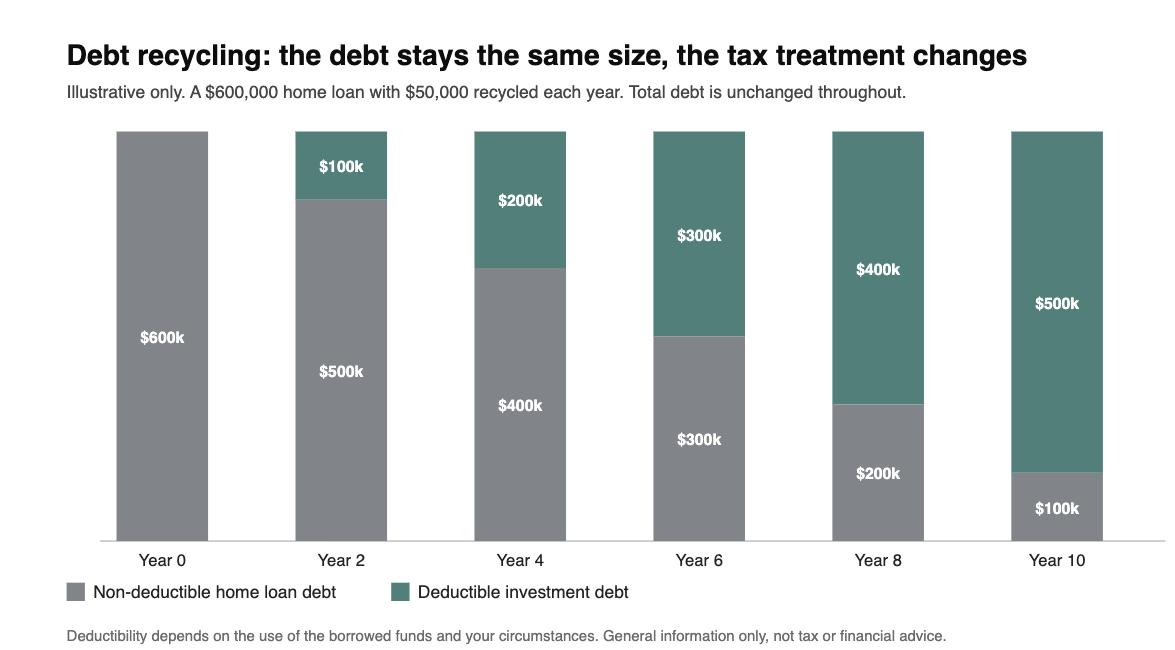
Note what the chart doesn’t show, because this is the honest version. It doesn’t show the value of the investments you bought with that teal portion. They might be worth more than you paid. They might be worth a lot less. The debt is certain. The rest isn’t.
How debt recycling works, step by step
- You have surplus cash, or you build it up in an offset against the home loan.
- You make a lump sum repayment off the home loan with that cash. The balance genuinely drops.
- You draw the same amount back out, through a separate loan split set up for the purpose. Not redraw on the existing loan. A clean, separate account.
- Those funds go straight into the investment, with nothing else mixed in and no detour through your everyday account.
- The interest on that split is now generally deductible, because the borrowed money was used to produce income.
- You repeat it as more surplus cash appears, and the deductible share of your total debt grows over time.
Step 3 is where most of the damage gets done, and it’s the step people are most casual about. More on that further down.
The numbers on a single $50,000 slice
Say you owe $600,000 at 6.00% and you’ve got $50,000 spare. Two options.
Option one, just pay down the loan. You save $3,000 a year in interest. That saving is certain, it’s risk free, and it’s tax free. There’s nothing to review and nothing to go wrong.
Option two, recycle it. Repay the $50,000, redraw it through a new split, invest it. The split costs $3,000 a year in interest. On a 37% marginal rate plus Medicare, that deduction is worth about $1,170, so your after-tax interest cost is roughly $1,830, or an effective rate of about 3.7%.
So the bar is 3.7%. The investment has to beat that, after tax and after costs, over whatever period you hold it, or you would have been better off in option one. That’s a low bar over twenty years and a completely unreliable one over three.
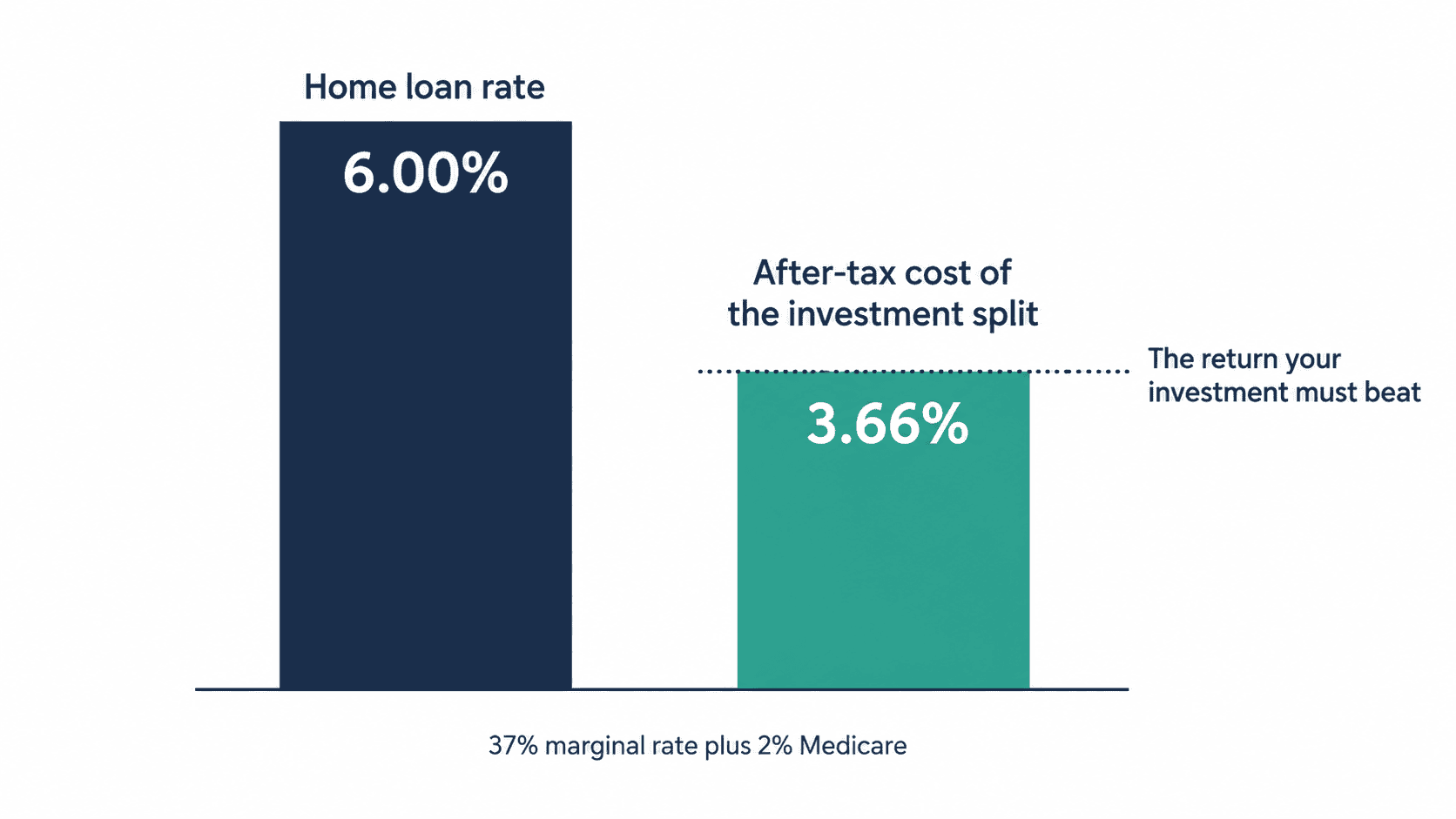
A few things that quietly move the bar. Dividends and distributions are assessable income, so the investment earnings get taxed on the way in. Selling later triggers capital gains tax. If your marginal rate is 15% or 30% rather than 37% or 45%, the deduction is worth much less and the whole case weakens. And if your income drops, the deduction drops with it.
Debt recycling calculator: run your own slice
Put in your own numbers. The calculator does the $50,000 example above for any slice, tax bracket and return you like, then shows you the version nobody puts in the brochure: what happens if the market drops 30% the year after you start.
The lump sum you repay off the home loan and borrow back through a new split.
The rate on the new investment split. Usually the same as your home loan.
2026-27 brackets. Medicare levy of 2% is added automatically.
Income plus growth, before tax. Nobody knows this number. Try a few.
Dividends or distributions. Taxed each year at your marginal rate, then reinvested.
Assumes you sell at the end and pay capital gains tax with the 50% discount.
Return the investment must beat
–
Your after-tax borrowing cost. Below this, paying down the loan wins.
After-tax interest per year
–
–
Result after 10 years, at your return
–
Compared with simply paying the same amount off the home loan.
Same slice, market falls 30% in year one
–
Then earns your expected return every year after. This is the number to sit with.
Illustration only, not advice or a projection. Interest is assumed paid from cash flow each year, income is taxed yearly at your marginal rate plus Medicare and reinvested, growth is taxed on sale with the 50% CGT discount, and the split is repaid from the proceeds. Franking credits, fees, brokerage and rate changes are ignored. Speak to a licensed financial adviser and a registered tax agent.
What actually goes wrong
These are the failure modes, in roughly the order I see them cause pain.
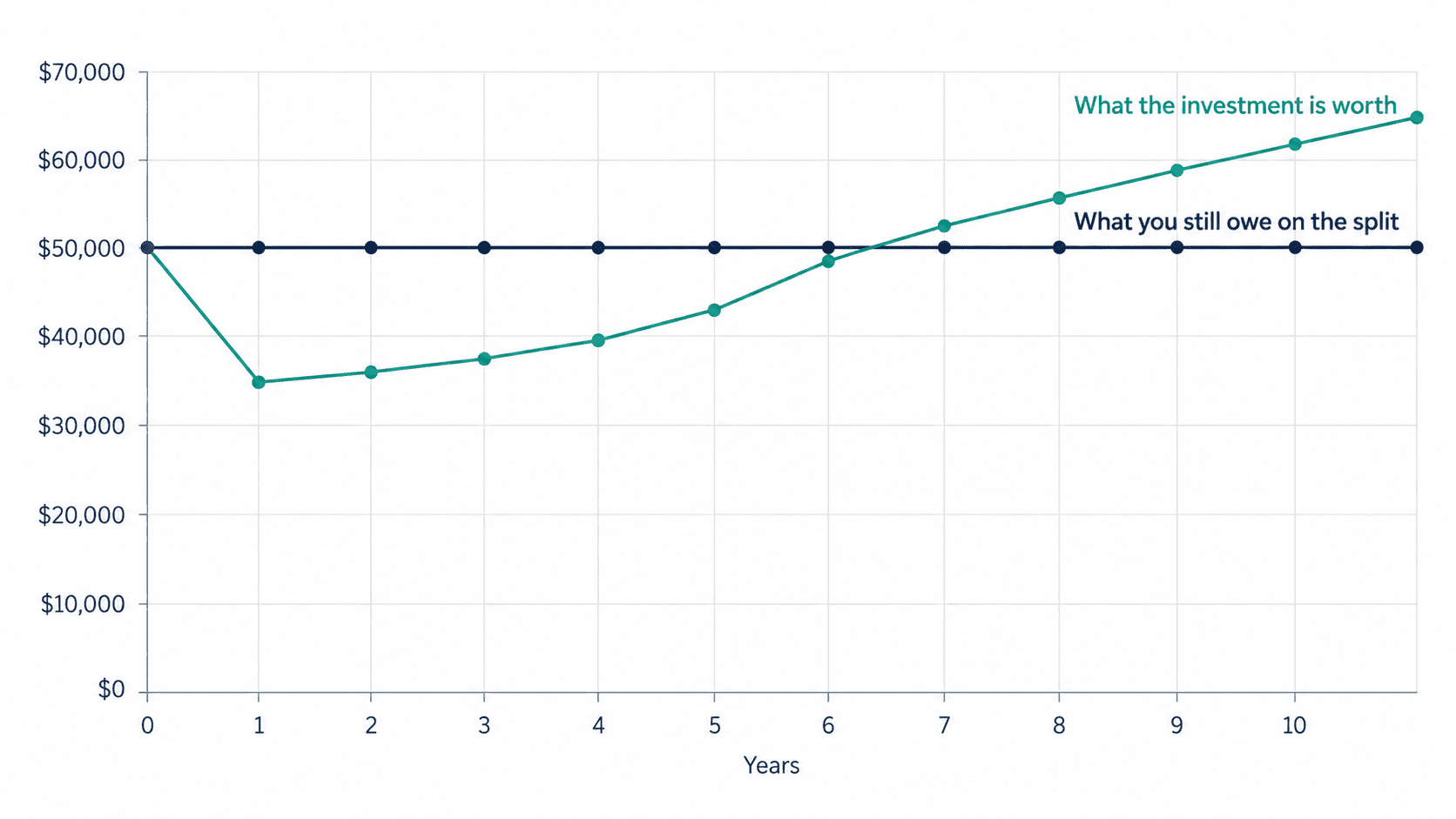
- The market falls and the debt doesn’t. This is the whole risk in one line. A 30% drawdown two years in leaves you with the same interest bill and a much smaller asset, and the deduction is no comfort at all. If you’d paid down the mortgage instead, you’d simply owe less.
- Sequencing. Starting right before a bad stretch is very different from starting right before a good one, even if the twenty-year average is identical. You don’t get to choose which one you got.
- Cash flow. You’ve added an interest bill that has to be paid every month whether the investment pays anything or not. Shares can cut distributions. Your lender won’t.
- Rate rises hit twice. Higher rates raise the cost of the investment split and raise the return you need to justify it.
- Mixed purpose loans. Put personal spending through the investment split, even once, and you’ve created a mixed purpose loan. Every future repayment gets apportioned across both purposes and the deductible portion can only shrink. It is genuinely difficult to unwind.
- Selling under pressure. Job loss, illness or a relationship breakdown at the wrong moment forces a sale at the wrong price, and you crystallise the loss plus a CGT event.
- Concentration. Recycling into a single stock or a single sector is a different risk again from recycling into something diversified.
- Part IVA. The general anti-avoidance provisions can apply to arrangements that are contrived rather than commercial. Structures that exist mainly to manufacture a deduction attract attention.
Who debt recycling isn’t for
I’d rather be blunt about this than have someone read the tax bit and get excited. From what I see in loan files, this strategy sits badly with:
- Anyone on a low or middling marginal tax rate, because the deduction is the entire point and it’s worth very little at 15%.
- Anyone whose income is about to change. Parental leave, a career break, contract work, a business in its first couple of years.
- Anyone without a cash buffer sitting completely outside the strategy.
- Anyone who hasn’t lived through a market drop and honestly doesn’t know how they’ll react to one.
- Anyone with a horizon shorter than about ten years.
- Anyone planning to move, renovate heavily, or turn the home into an investment in the next few years, because all of those change the tax picture.
- Anyone whose lender won’t give them clean splits, which is more common than you’d think on older loans and basic products.
The loan structure mistakes I see most
This is my actual lane, so it’s where I’ll be most useful. Whether or not debt recycling is right for you is a question for a licensed adviser. Whether the loan has been set up in a way that survives an audit is a question for your broker.
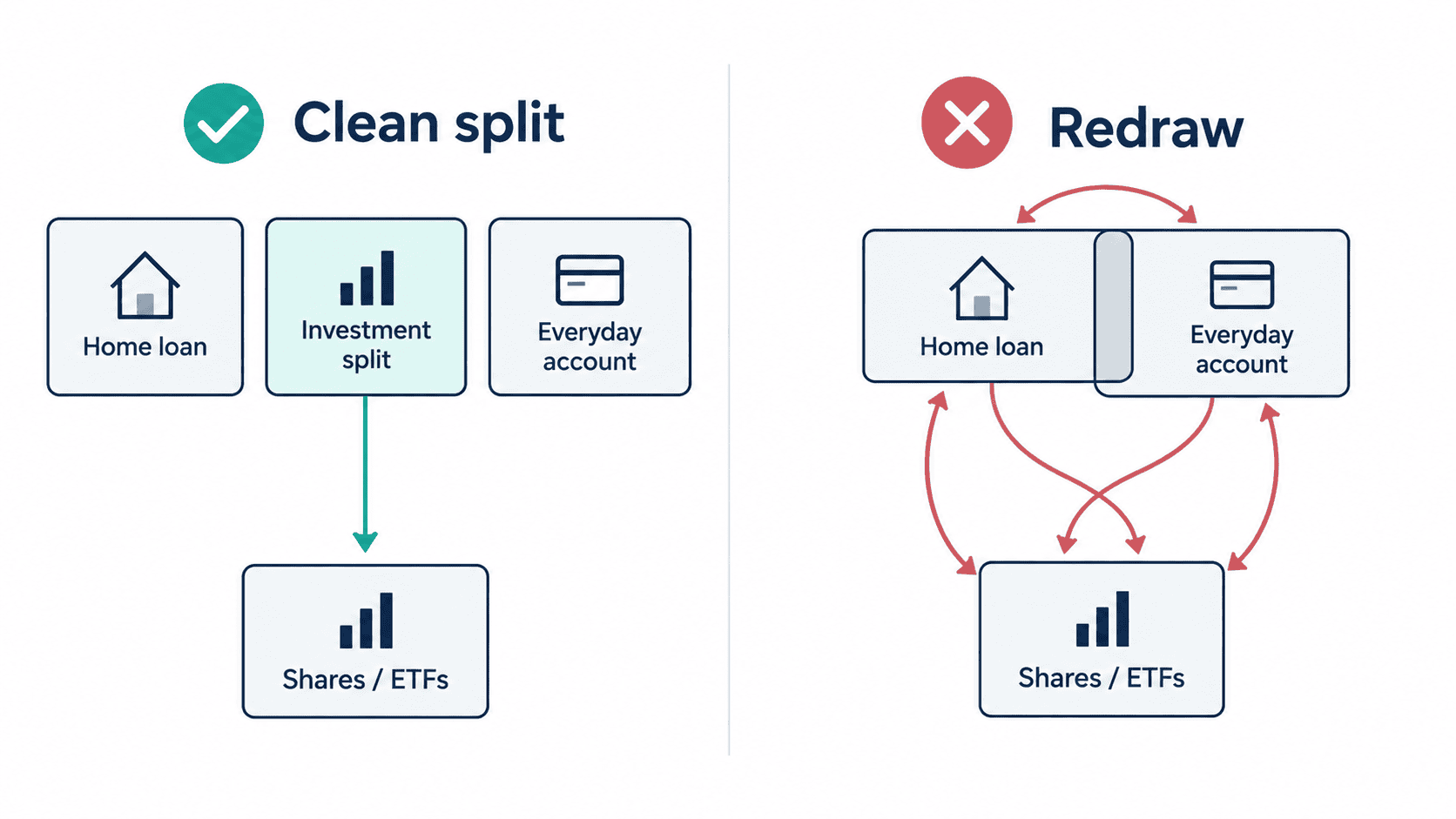
- Using redraw instead of a new split. Redrawing on the existing home loan puts investment borrowing and personal borrowing in the same account. That’s the mixed purpose problem, created on day one, for no reason other than it was quicker.
- Letting the split get contaminated. One transfer, one card transaction, one accidental BPAY out of the investment split and the clean line disappears. Treat that account as untouchable.
- Parking dividends in the split. Depositing investment income into the investment split is a repayment. Taking it back out is new borrowing with a new purpose. Keep income flowing somewhere else.
- One offset across mixed splits. Most lenders link one offset to one loan account, so decide deliberately which split it attaches to. Our offset calculator shows what that choice is worth in dollars, and it’s worth checking the link is even live while you’re in there.
- No paper trail. Keep the settlement statements, the transfer records and the purpose of every drawdown. Your accountant will need them years from now and your memory won’t be good enough.
- Fixed rate loans. Extra repayment caps and no split flexibility make fixed loans an awkward fit. Check the contract before you plan anything.
- Assuming the lender will play along. Some lenders are slow or unwilling to create multiple small splits, and some charge per split. Establish this before the strategy depends on it.
What you need in place before you go near it
- Personal advice from a licensed financial adviser who has looked at your full position, not a forum thread and not this post.
- An accountant who has confirmed the deductibility of what you’re actually planning to do, in writing.
- An emergency buffer that is not part of the strategy and not invested.
- Income you can rely on for the next several years, and insurance that reflects that.
- A loan structure with clean, separate splits, agreed with your lender before any money moves.
- A written plan for what you do if the investment falls 30%, decided while you’re calm.
If you’re still reading and want the plain-English background on borrowing to invest, ASIC’s Moneysmart is a sensible place to start, and the ATO is the authority on what is and isn’t deductible.
Debt recycling questions I get asked
Is debt recycling legal in Australia?
Yes. It relies on the ordinary rule that interest is deductible when the borrowed funds are used to produce assessable income. There’s nothing clever or hidden about it. What can cause a problem is sloppy execution, or an arrangement that’s been engineered purely for the deduction, which is where the anti-avoidance provisions come in. Your accountant should sign off on the specifics.
Can I do debt recycling with an offset account?
Not directly, and this trips people up constantly. Money sitting in an offset is your own savings, not a repayment. Taking it out and investing it isn’t borrowing, so it creates no deductible interest. The offset is a useful place to accumulate the cash beforehand, but the repayment and the redraw through a separate split still have to happen.
How long does debt recycling take?
Years, usually. Most people recycle in slices as surplus cash appears rather than in one hit, so a $600,000 home loan might take a decade or more to convert. That slow pace is a feature, since it spreads your entry points, but it also means the strategy has to survive a long time without your circumstances breaking it.
What happens if the market drops right after I start?
You owe the same amount and your investment is worth less. That’s the risk, in full, and no tax deduction changes it. The people who handle it are the ones who decided in advance that they wouldn’t sell and who had enough cash outside the strategy not to have to. The calculator above has a button for exactly this scenario.
Is debt recycling the same as a home equity investment loan?
No. Borrowing against your equity to invest increases your total debt. Debt recycling keeps the total the same and changes the mix. The risk profile is different, and lenders assess them differently too.
Can I recycle into an investment property instead of shares?
The deductibility principle is the same, but the practicalities aren’t. Investment property comes in one large lump rather than in slices, needs stamp duty and buying costs that aren’t deductible up front, and can’t be sold in pieces if you need cash. Different strategy, same tax logic.
Where I’d leave it
Debt recycling is a real strategy with a real tax benefit, and it’s also the strategy I see explained most dishonestly online, usually by leaving out the bit where markets fall. The tax deduction is certain. The return isn’t. Anyone selling you the first without dwelling on the second is not on your side.
If you’ve already taken advice and the loan side needs building properly, that part we can help with. Email startnow@sorenfinancial.com and we’ll look at whether your lender can give you clean splits, what it costs, and how to keep the accounts uncontaminated. Or start with the button below and we’ll call you back within one business hour.
General information only. This is not financial, tax or credit advice, it doesn’t take your objectives or situation into account, and it isn’t a recommendation to use debt recycling or any other strategy. Borrowing to invest increases both potential gains and potential losses. Figures used are examples only, and the calculator is an illustration, not a projection. Speak to a licensed financial adviser and a registered tax agent before acting.
About the author

Mansour Soltani
Director, Soren Financial
Mansour leads Soren Financial, working with clients across home loans, refinancing and property investment. A regular media contributor to ABC, Domain and Australian Broker, he holds a Certificate IV and Diploma in Finance and Mortgage Broking.
View full profile →