
Land Subdivision Finance
Whether you’re splitting a suburban block into two lots or staging a multi-lot residential estate, land subdivision finance can fund both the land purchase and the civil works that follow. Soren Financial’s commercial brokers help you secure it from a panel of 20+ banks and specialist lenders across Australia.
We’ll help you understand what lenders are actually assessing, structure your application around it, and secure a loan that suits the scale and timeline of your subdivision.
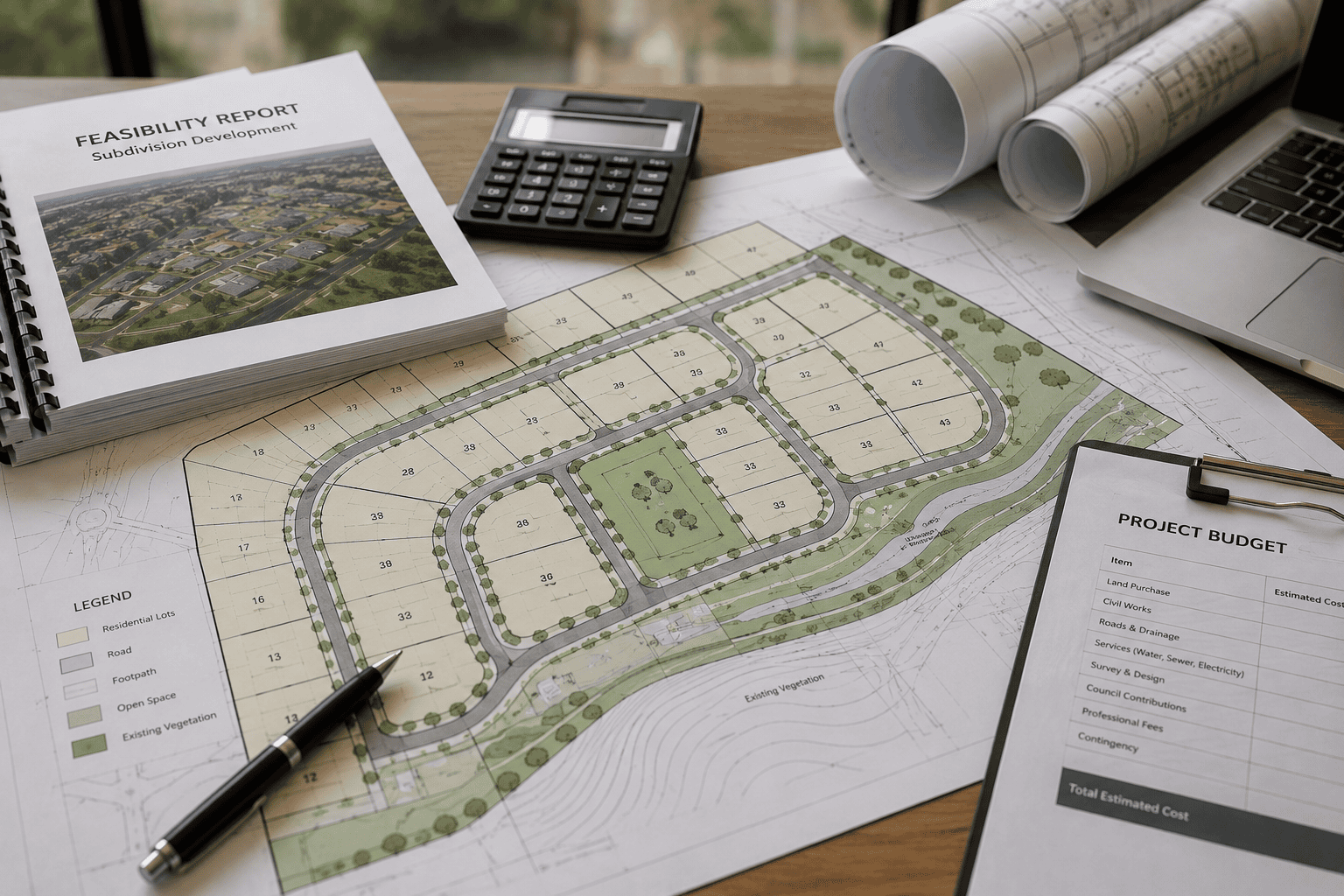
Land subdivision finance options we can help with
We arrange loans for residential and commercial subdivision projects of almost every size. The structure, deposit and term differ significantly between the two, so it’s worth understanding where your project sits before you approach a lender.
Residential subdivision finance | Commercial subdivision finance | |
Suitable for | Two-lot subdivisions, dual occupancies and small residential developments | Multi-lot residential estates, industrial subdivisions, commercial developments and mixed-use projects |
Maximum loan size | Varies by lender | Up to $50 million |
Maximum LVR | Up to 80% of total development cost | Typically 65–75% of total development cost |
Loan term | Up to 30 years | Typically 5–20 years |
Interest rates | From 7.50% p.a.* | From 8.50% p.a.* |
Repayments | Interest-only during construction available | Progressive drawdowns linked to project milestones |
Funds released | Lump sum or progressive drawdowns | Progressive drawdowns linked to project milestones |
Pre-sales | Often not required | Larger projects usually require pre-sales or pre-lease commitments, depending on the lender |
*Rates vary depending on the lender, project size, LVR and borrower profile.
Subdivision projects we can help you get finance for
Two-lot subdivisions
Finance for homeowners or investors subdividing an existing residential block into two separate lots. This is the most common entry point into subdivision, and often the simplest to fund.
Dual occupancy developments
Funding to subdivide land and construct two separate dwellings under Torrens or strata title.
Multi-lot residential subdivisions
Finance for developers creating residential estates with multiple new housing lots, typically funded in stages against a delivery program.
Industrial subdivisions
Funding for industrial land developments, warehouses and business parks, including projects with pre-lease commitments in place.
Commercial subdivisions
Finance for office, retail or mixed-use developments involving multiple land titles.
Strata and community title subdivisions
Funding for projects involving strata title apartments, townhouses or community title developments.
Greenfield developments
Finance for large-scale residential land releases involving roads, utilities and other civil infrastructure.
How land subdivision finance works
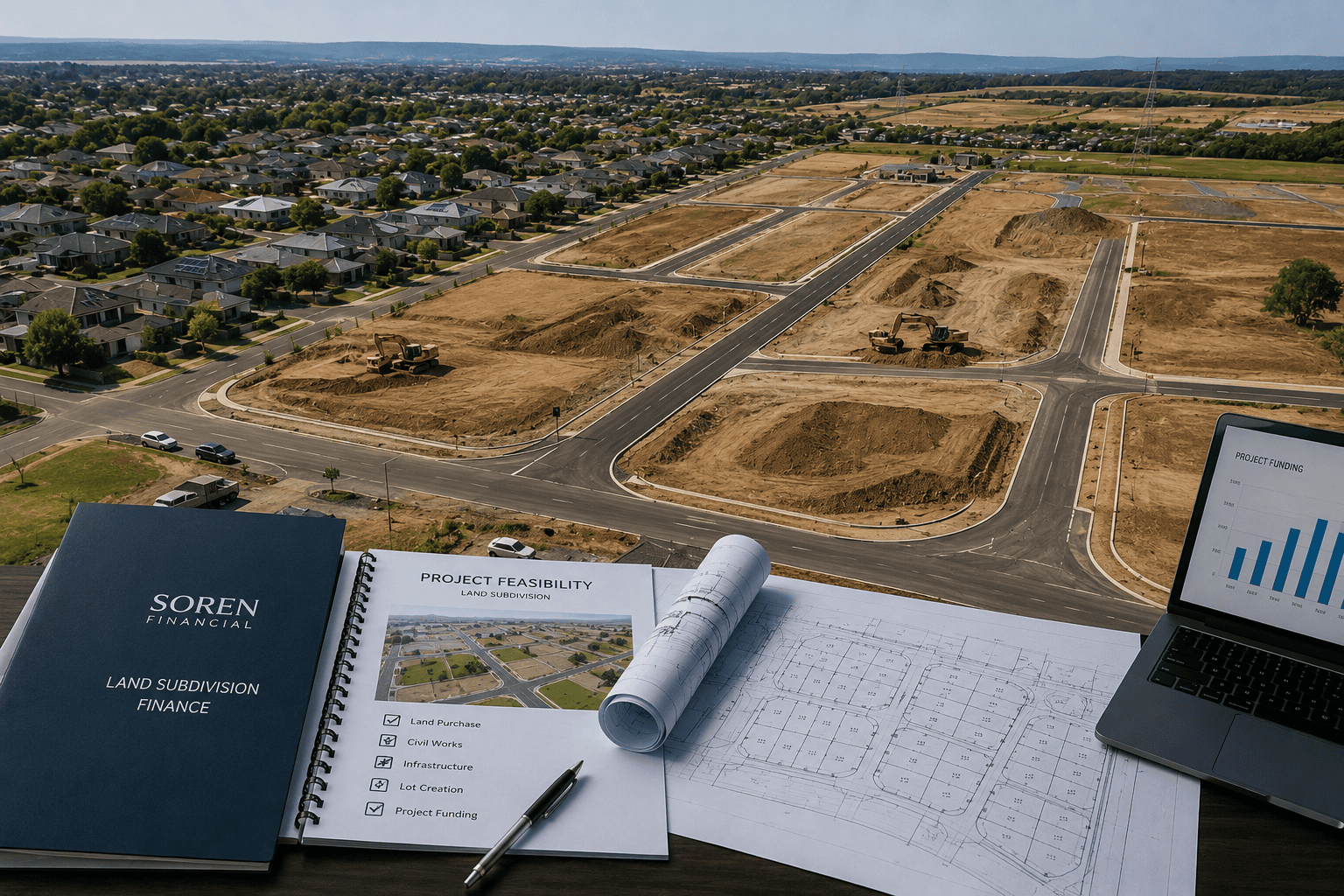
This type of finance can cover both the purchase of the land and the costs of developing it for subdivision. Loans are typically structured in two parts:
- Land loan: Funds the purchase of the site, with lenders generally financing 65%–90% of the land value.
- Development loan: Covers the costs of preparing the land for sale or future construction.
Rather than receiving the full loan upfront, funds are usually released in staged drawdowns as the project progresses. Depending on the development, finance can be used to cover:
- Land purchase
- Civil works
- Road and drainage construction
- Water, sewer and electricity connections
- Surveying costs
- Council contributions and infrastructure charges
- Professional fees
- Interest during construction
Before each drawdown, the lender may require a progress inspection or a report from a quantity surveyor to confirm that completed works meet project milestones and comply with approved plans.
Once the subdivision is complete and individual titles have been issued, the loan is typically repaid through the sale of the newly created lots or refinanced into a longer-term loan if you plan to retain the property.
Applying for a land subdivision loan
Before approving a subdivision loan, lenders assess the long-term viability of the project and their exposure if it stalls. That means the application is more involved than a residential mortgage, but it’s predictable, and preparation makes a measurable difference to your outcome.
What you’ll generally need to provide:
- Full financial records for all borrowers, including income streams, credit history and any previous property development experience
- Project feasibility reporting, including the ‘as if complete’ value of the subdivision, which is often used to determine the loan-to-value ratio (LVR)
- Council-approved development plans, alongside any other relevant planning approvals or permits
- Costed timelines, including construction, surveying and engineering quotes, plus other project costs
- A clear exit strategy demonstrating how the loan will be repaid, whether by sale or refinance
On larger projects delivering a significant number of dwellings, whether residential or commercial, you may also need evidence of pre-sales to support viability.
How much you'll need to contribute
These two products overlap, and the right one depends on what your project actually delivers.
- Land subdivision finance is appropriate where the primary outcome is new titles, meaning you’re dividing land, delivering civil works and servicing, and selling or retaining the resulting lots. Construction of dwellings may or may not follow.
- Property development finance is appropriate where the primary outcome is completed buildings. This includes apartments, townhouses or commercial floor space, with the construction cost dominating the budget.
Many projects involve both, and lenders will often fund them under a single facility staged across land, civil and construction phases. If you’re unsure which describes your project, read more about our property development finance or talk to a broker and we’ll work it out with you.
Land subdivision finance FAQs
What’s a land subdivision loan?
A land subdivision loan is a specialised residential or commercial property loan designed to fund the purchase of land and the costs associated with dividing one property into multiple titles.
Do I need development approval before applying for land subdivision finance?
You can apply before receiving development approval, but securing DA first is generally the stronger position. It reduces lender uncertainty and makes approval considerably more likely, often on better terms.
Can I subdivide my existing property?
Yes. A subdivision loan can fund the subdivision of a property you already own, and in that scenario you can use your existing equity to secure the loan. The rest of the assessment like subdivision costs, expected completion value, exit strategy works the same way.
How are loan funds released?
Through progressive drawdowns as milestones are completed, rather than as a single lump sum. You’ll receive an initial advance to facilitate land purchase, followed by further drawdowns at defined project stages as works progress.
Do I need a valuation for a subdivision loan?
Yes. Lenders generally require an independent valuation covering both current ‘as is’ land value and the ‘as if complete’ value of the finished subdivision. Larger projects may also require a quantity surveyor’s report on costings before settlement and at each drawdown.
How long does approval take for a subdivision loan?
Approval timelines vary considerably by lender. Some private lenders can approve applications within 72 hours. With major banks, the typical lead time is two to six weeks, and longer where the project is complex or documentation is incomplete.
Can I get subdivision finance without previous development experience?
Yes, though it affects your options. First-time developers are more likely to be funded on smaller projects, at lower LVRs, or with a builder and project team the lender recognises. Presenting a well-evidenced feasibility and a credible delivery team goes a long way here.
What happens if my project runs over time or over budget?
Cost overruns are common enough that lenders plan for them. Facilities usually include a contingency allowance, and extensions can often be negotiated, though generally at additional cost. Building realistic contingency into your feasibility from the outset is the better protection.
Is GST payable when I sell subdivided lots?
It can be, depending on whether the sale is treated as an enterprise and whether the margin scheme applies. This is a tax question rather than a lending one, and the answer varies materially by circumstance. Speak to your accountant before you model your returns.
Why choose Soren Financial?

At Soren Financial, our professional brokers are committed to excellence. We offer:
- access to 20+ commercial lenders
- commercial property, business and development finance specialists
- tailored lending structures for complex scenarios
- experience with owner-occupied, investment and SMSF lending
- end-to-end support from strategy through to settlement.
We can help you navigate the loan application and approval process with ease and successfully fund your subdivision project, no matter its size. Contact us to find out more.