
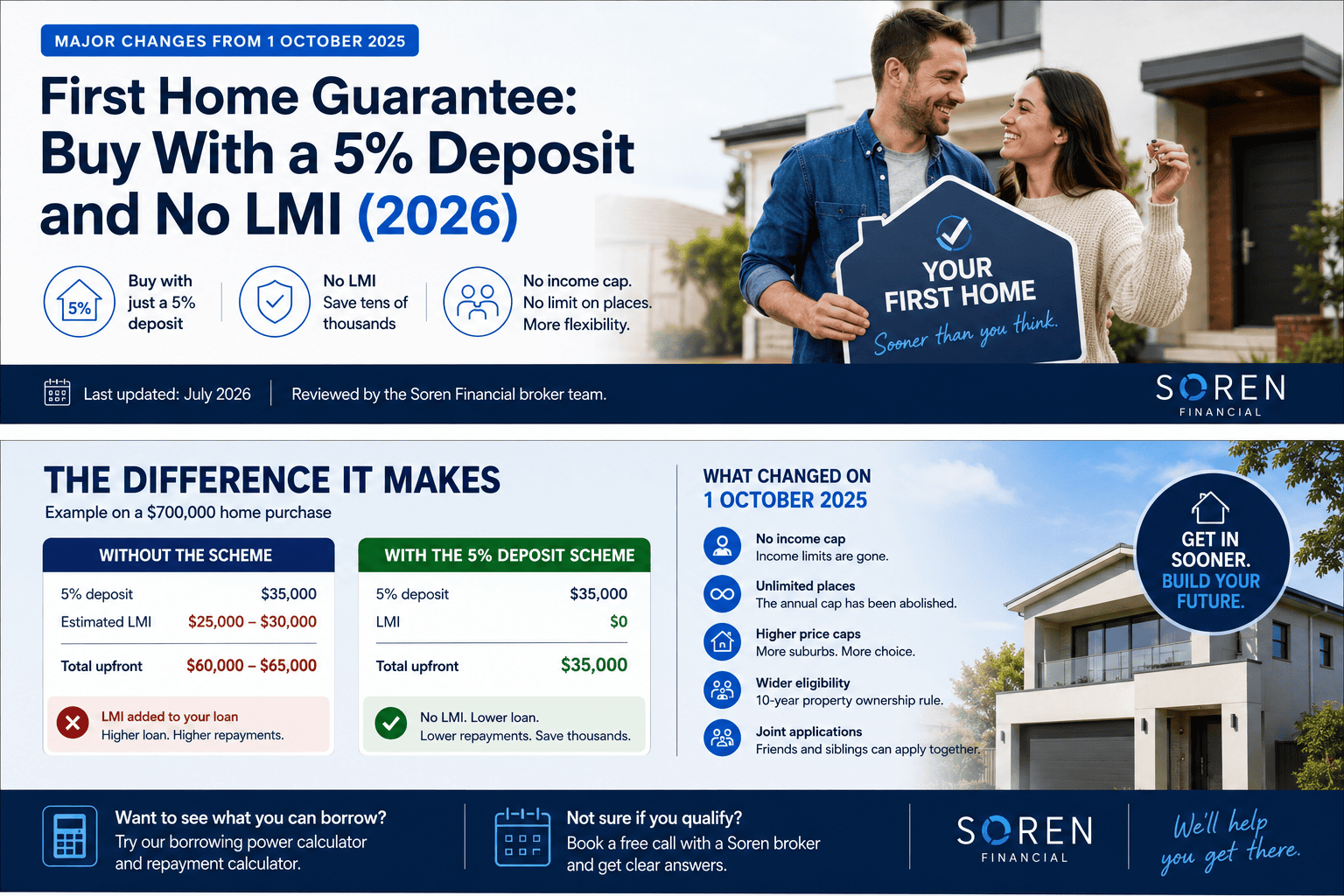
Last updated: October 2026. Reviewed by the Soren Financial broker team.
If saving a 20% deposit feels out of reach, you are not alone, and the good news is you probably don’t need one. The Australian Government 5% Deposit Scheme, which most people still call the First Home Guarantee, lets eligible first home buyers buy with a deposit as small as 5% and pay no Lenders Mortgage Insurance. On an $800,000 home, that is the gap between saving $40,000 and saving $160,000. For a lot of buyers it means getting in years earlier.
The catch is that the scheme changed a lot on 1 October 2025, so a fair bit of the advice floating around online is now simply wrong. Here is where things really stand for 2026.
This is the deep-dive on the guarantee. For the full first home buyer picture, including deposits, loan types, other schemes and the application process, start with our first home buyer guide.
What the First Home Guarantee actually does
Borrow more than 80% of a property’s value and, normally, the lender slaps on Lenders Mortgage Insurance. It protects them, not you, and it usually gets bolted straight onto what you owe. The guarantee makes that cost go away. What the government does is back the slice of your loan your deposit doesn’t cover, up to 15% of the value, which lets the lender treat you as though you had put down the full 20%. You bring 5%, the guarantee covers the gap, the insurance disappears.
None of it is a cash handout, and the government never owns a piece of your home. The guarantee just sits quietly behind the loan, and the day your balance drops under 80% of the value, you can ask for it to come off.
What changed on 1 October 2025
This is where most online guides are out of date. From 1 October 2025 the scheme went from a limited, competitive program to one nearly every first home buyer can use:
- No income cap. The old limits of $125,000 for singles and $200,000 for couples are gone. Your income no longer rules you out.
- Unlimited places. The scheme used to be capped at a set number of spots each year, which ran out. That cap has been abolished.
- Higher property price caps. The caps rose sharply, bringing realistic Sydney and Melbourne prices into range (full table below).
- A wider definition of first home buyer. You can qualify if you haven’t owned property in Australia in the past 10 years, even if you owned one before that.
- Bigger joint applications. Two or more eligible buyers can apply together, including friends or siblings, not just couples.

Half the people who tell me they don’t qualify are working off last year’s rules. The income cap is gone and the places no longer run out, so the question is rarely whether you are allowed, it is which lender’s version of the scheme suits you. That is the part worth getting right.
Mansour Soltani, Soren Financial
What it’s worth: a worked example
Picture a $700,000 purchase. With a small deposit and no scheme behind you, the LMI bill lands somewhere near $25,000 to $30,000, usually added to the loan and quietly earning the bank interest for the next thirty years. Under the guarantee you hand over none of it, and the repayments stay lower the whole way through. You can test your own numbers with our borrowing power calculator and repayment calculator.
Who qualifies in 2026
Eligibility is simpler than it used to be. To use the guarantee you generally need to:
- Be an Australian citizen or permanent resident, and at least 18.
- Be a first home buyer, or not have owned property in Australia in the past 10 years.
- Buy a home you will live in (owner-occupied, not an investment) and move in within the required period after settlement.
- Have a deposit of at least 5% (2% under the separate Family Home Guarantee, below).
- Buy under the price cap for your location.
There is no income test and no cap on places, so the two things left to clear are the property price cap and normal lender serviceability, which is exactly what a broker helps you work through.
2026 property price caps
Both the purchase price and the lender’s valuation must sit at or below the cap for your location. Caps are higher in capital cities and designated regional centres:
| State | Capital city & regional centres | Rest of state |
|---|---|---|
| New South Wales | $1,500,000 | $800,000 |
| Victoria | $950,000 | $650,000 |
| Queensland | $1,000,000 | $700,000 |
| Western Australia | $850,000 | $600,000 |
| South Australia | $900,000 | $500,000 |
| Tasmania | $700,000 | $550,000 |
| Territory | Price cap |
|---|---|
| Australian Capital Territory (all areas) | $1,000,000 |
| Northern Territory, Darwin | $750,000 |
| Northern Territory, rest of Territory | $600,000 |
NSW regional centres include the Central Coast, Newcastle and Lake Macquarie, Illawarra, Mid North Coast, Coffs Harbour to Grafton and Richmond to Tweed. In Victoria the regional centre is Geelong, and in Queensland they are the Gold Coast and Sunshine Coast. Some suburbs span more than one postcode with different caps, so always confirm the exact cap for your address.
What you can buy
The scheme is flexible on property type. You can use it for an existing house, townhouse or apartment, a house-and-land package, an off-the-plan purchase, or vacant land with a separate building contract, as long as the total comes in under the cap.
The other guarantees
The 5% Deposit Scheme is the main one, but two related programs sit alongside it:
- Family Home Guarantee, for eligible single parents and guardians with at least one dependent, allowing a deposit as low as 2% with no LMI. We cover it in our guide to the Family Home Guarantee for single parents.
- Help to Buy, a shared-equity scheme where the government takes a stake in your home in return for a smaller deposit. It is income-tested and offered through a limited set of lenders.
Which lenders offer it
The guarantee runs through a panel of participating lenders, from the major banks to smaller and customer-owned banks, including Commonwealth Bank, Westpac and NAB, along with the likes of Great Southern Bank, Bendigo Bank and Bank First, among many others. You apply through a participating lender or a broker, not directly to the government, and each lender layers its own rates, serviceability rules and turnaround times on top of the scheme. That is why the same borrower can be a comfortable yes at one lender and a no at another.
If you don’t qualify
Missing out on the guarantee does not mean you are stuck at 20%. Two common alternatives:
- A guarantor loan, where a parent uses the equity in their home as extra security so you can borrow up to 100% and still avoid LMI.
- A standard low-deposit loan with LMI, where you pay the premium but still get in with a small deposit. It is often less than people fear, and buying sooner sometimes beats waiting. Our guide on how to avoid LMI runs through every route.
How to apply
- Talk to a broker or participating lender first, so you confirm your eligibility and which lenders have the scheme open.
- Get your borrowing capacity and pre-approval sorted before you house-hunt, so you know your cap and your budget.
- Find a property under the price cap for your postcode.
- Your lender reserves a guarantee spot and processes the loan through to settlement.
Because lenders each handle the scheme slightly differently, the lender you choose matters as much as the scheme itself.
The scheme is the same everywhere, but the loan around it isn’t. Getting matched to the right lender is where the real money is, on rate, on how much you can borrow, and on whether you are approved at all.
Mansour Soltani, Soren Financial
First Home Guarantee FAQs
Can I really buy with a 5% deposit and no LMI?
Yes. Under the Australian Government 5% Deposit Scheme (First Home Guarantee), eligible first home buyers borrow up to 95% with the government guaranteeing the gap, so no LMI is charged.
Is there still an income limit?
No. The income caps were removed on 1 October 2025. Your income no longer disqualifies you from the scheme.
Do the places still run out each year?
No. The annual cap on places was abolished in October 2025, so every eligible applicant can access the guarantee.
Can I use it if I owned a home years ago?
Possibly. Since October 2025 you can qualify if you haven’t owned property in Australia in the past 10 years, even if you owned one before that.
Can two friends apply together?
Yes. Joint applications are open to two or more eligible first home buyers, including friends and siblings, not only couples.
Can I use the scheme for an investment property?
No. The home must be one you live in. It can’t be a pure investment purchase.
How much can I borrow under the scheme?
That depends on your income, expenses and the lender, not the scheme itself. Use our borrowing power calculator for a guide, then we confirm it against real lender policies.
Related first home buyer guides
- First Home Buyer Guide (2026) – our complete guide to deposits, loan types, costs, borrowing power and every scheme.
- Family Home Guarantee for single parents – buy with just a 2% deposit and no LMI.
- How to avoid Lenders Mortgage Insurance – every legitimate way to skip the LMI premium.
- Borrowing power calculator – estimate how much you can borrow.
- Home loan repayment calculator – work out your repayments.
This information is general only and doesn’t take your circumstances into account. Eligibility, price caps and lender policies are set by the Australian Government and individual lenders and can change. Confirm the current price cap for your postcode before you buy.