
I have been writing home loans long enough to notice that the same personal finance mistakes turn up again and again, and almost none of them are about people being reckless with money. They are usually about people not having a system. Then a lender asks for twelve months of bank statements and the whole thing gets very real, very quickly.
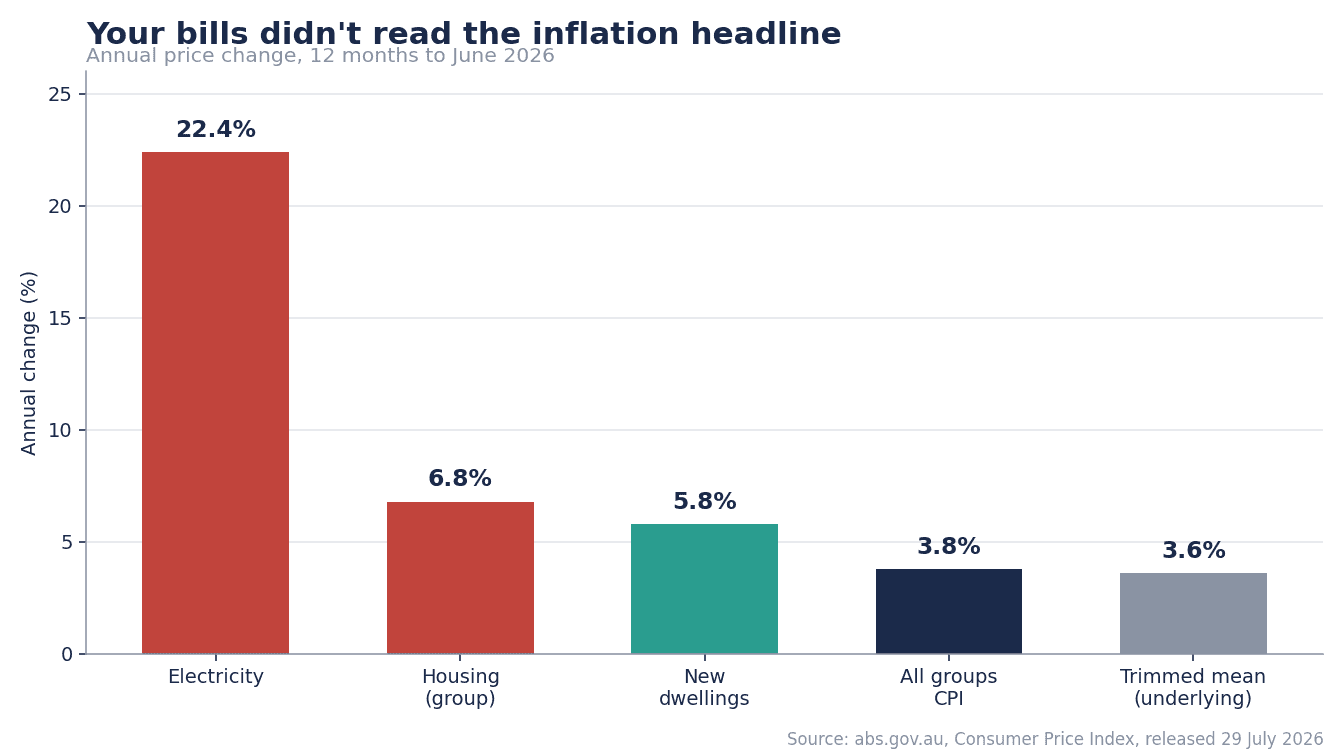
Here is the bit that makes 2026 harder than the last couple of years. Headline inflation came in at 3.8% for the year to June, which sounds almost civilised. Your actual bills did not get that memo. Electricity was up 22.4% over the same twelve months, largely because the government rebates that were softening those bills have ended, and housing costs across the board rose 6.8%. So if you feel like you are earning more and going backwards, you are not imagining it.
Want a second set of eyes on your numbers before a lender puts them under a microscope? Email me at startnow@sorenfinancial.com and we will go through what your position actually looks like.
1. You have no idea what you actually spend
Not a criticism. Almost nobody does. People can tell me their salary to the dollar and then guess their monthly spending, and the guess is usually out by a third.
This is the one mistake that costs you twice. It costs you in the obvious way, where money leaks out and you never see it leave. It also costs you at application time, because a lender does not care what you told them your expenses are. They pull your statements and they read them. Every subscription, every Uber Eats order, every gambling transaction, all of it.
Most people don’t have a money problem, they have a ‘where did it go’ problem. The budget isn’t the boring bit, it’s the whole game.
Mansour Soltani, Soren Financial
Fixing it is boring and it works. Pull three months of statements, put every transaction into a category, and look at the total. That is your real number. The Moneysmart budget planner is free and does the job, so there is no need to buy an app for it. And if you are heading toward an application, read the 8 things you should not be doing when applying for a loan before you do anything else.
2. Saving hard, but with no structure behind it
Plenty of people save well and still leave money on the table, because they save into the wrong place. If you are buying your first home, the First Home Super Saver scheme is the clearest example.
You can put up to $15,000 of voluntary contributions into super in any one financial year, up to $50,000 in total across all years, then withdraw it later for your deposit. The reason it works is tax. Voluntary concessional contributions are taxed at 15% going in, which for most people is well under their marginal rate, and released amounts also get a 30% tax offset. Same money, less of it going to the ATO.
Two things people get wrong with it. First, they assume it is a separate government pot of money, it is not, it is your own money saved in a lower tax environment. Second, and this one actually hurts, you have to request an FHSS determination from the ATO before ownership of the property transfers to you. Ask afterwards and you have missed it. Full detail is on the ATO’s FHSS page, and we keep the grants and stamp duty side of it current on our first home buyer grants page.
3. Leaving cash somewhere it does nothing
If you already have a mortgage and you are also holding savings in a separate account, you are almost certainly paying more interest than you need to. Your home loan rate is higher than what your savings account pays you. It is higher after tax by an even wider margin. Money sitting in the savings account is losing that difference every single day.
An offset account fixes it without you doing anything clever. Same accessible cash, but it reduces the balance your interest is calculated on. The catch is that a surprising number of people have an offset account that is not actually linked, or is linked to the wrong split, and they never find out. Worth checking: here is how to tell if your offset account is doing its job.
4. Budgeting for a rate cut that has not turned up
This one has cost people real money over the last eighteen months. A lot of households built their budget around the assumption that rates were about to fall and they just had to hang on.
They have not fallen. The cash rate is 4.35%, and the RBA has raised it three times since the start of 2026, holding it steady at the June meeting while it waits to see how the economy responds. The Board’s own language leaves the door open to going further if inflation does not behave.
As I write this, our rate prediction index over at OurTop10 has the market and the tracked economist panel at 0% chance of a cut, 91.7% hold and 8.3% hike for the 29 September meeting. You can see the live numbers on the OurTop10 Rate Prediction Index. Build your budget on the rate you are paying now, not the one you are hoping for. If it works at today’s rate, a cut is a bonus. If it only works after a cut, that is not a budget, that is a wish.
5. No buffer, and no cover
An emergency fund and insurance are the two things people skip because nothing has gone wrong yet. Three to six months of living expenses is the standard rule of thumb and it is a good one, but I would frame it differently. A buffer is what stops a bad month turning into a bad decision. Without one, a broken car becomes credit card debt, and credit card debt becomes a problem on your next loan application.
Same logic with insurance. Review it when your life changes, not when you remember it exists. New mortgage, new baby, new job, that is the trigger. And be honest about whether the default cover sitting inside your super would actually carry your household if your income stopped tomorrow.
The extra one: your super quietly changed and nobody told you
The old advice was to push your total super contribution up to 15% and let compounding do the work. Still decent advice, but the maths behind it has shifted and most people have not noticed.
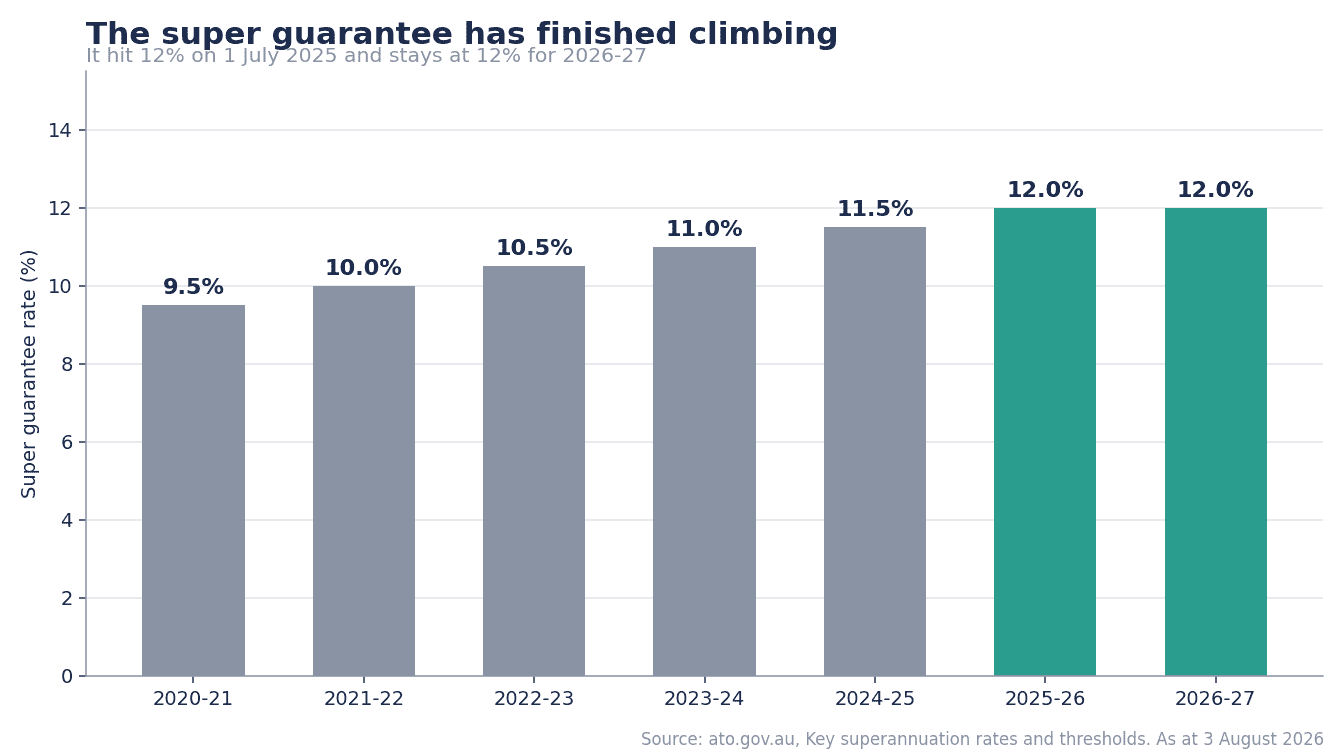
The super guarantee your employer pays is now 12%. It got there on 1 July 2025 and it stays at 12% for 2026-27, which was the last step in the schedule. So topping yourself up to 15% costs you roughly another 3% of your pay. A few years ago, when the guarantee was 10.5%, that same move cost you 4.5%. It is a cheaper hack than it used to be.
The number to watch is the concessional contributions cap, which is $32,500 for 2026-27, up from $30,000. That cap counts what your employer puts in as well as anything you salary sacrifice on top. Go over it and the excess gets added back to your taxable income and taxed at your marginal rate, which defeats the point entirely. Do the sum before you set the deduction, not after. One more change worth knowing: since 1 July 2026 your employer has to pay your super every payday rather than quarterly, so it is easier to check it is actually landing.
Which personal finance mistakes should you fix first?
Pick one. Seriously, one. The people who fix all five at once fix none of them. Start with the spending number, because every other decision on this list depends on knowing it.
Then run the numbers on the loan side. Our calculators will show you what your repayments and borrowing position look like, and what even small extra repayments do to the term of your loan is usually the thing that gets people moving.
If you would rather not do it alone, email me at startnow@sorenfinancial.com or get in touch here. We will look at your actual position and tell you straight whether there is money to be found.
Shameless plug: we are also listed as one of the top 10 mortgage brokers on ourtop10.com.au, and you can read what our clients have actually said about working with us.
About the author

Mansour Soltani
Director, Soren Financial
Mansour leads Soren Financial, working with clients across home loans, refinancing and property investment. A regular media contributor to ABC, Domain and Australian Broker, he holds a Certificate IV and Diploma in Finance and Mortgage Broking.
View full profile →