
Home Loans for Dentists in Australia: No LMI up to 95%

Financial Services Expert
“Most dentists I meet have already been told two different things by two different banks. One counted their billings, one didn’t. Neither was wrong about the policy — they just have different policies. The job is finding the lender that reads a dentist’s income the way a dentist actually earns it.”
Mansour Soltani – Director Soren Financial
Last updated: September 2026. Reviewed by the Soren Financial broker team.

If you are a registered dentist, a group of lenders will let you buy with a 5% to 10% deposit and waive Lender’s Mortgage Insurance altogether. On an $800,000 purchase with a 10% deposit that is roughly $32,000 you keep rather than add to the loan, and the saving is larger again at 5%.
Dentists sit in the top tier of these policies, alongside doctors and specialists. The waiver itself is rarely the hard part. What decides a dentist’s application is how the lender reads your income — because most dentists are not paid a salary, they are paid a share of what they bill, and lenders disagree about how to count that. This page is about that difference.
Want a quick read on where you stand first? Answer a few questions and see which medico home loan options could fit.
What are home loans for dentists?
There is no special dentist mortgage product. It is a normal home loan where the lender waives Lender’s Mortgage Insurance because of your profession, and often applies its professional-package pricing on top. Same offset, same redraw, same rates as anyone else on that package. The only thing that changes is the policy applied to your AHPRA registration.
Lenders do it because dentists are very good risks. Income is high and stable, the qualification takes years to earn and is not easily lost, and defaults in the profession are rare. Waiving a premium that exists to cover default risk costs them very little, and it wins a client who tends to stay for decades and come back for the practice loan later.
How much can a dentist borrow without LMI?
Registered dentists generally reach 90% of the property value with no LMI at a wide group of lenders, and 95% at a smaller group — a 5% deposit. That is the same tier as doctors and one step above nurses, who usually stop at 90%.
Two things to know about the 95% tier. First, the lenders that go there usually cap the loan size, so a very large purchase may need to sit at 90%. Second, the loan is still assessed on your income and living costs like any other; the waiver removes a cost, it does not add borrowing power. Plan on 90% and treat 95% as a bonus if your numbers support it.
The problem is not the deposit. It is how you are paid.
Most dentists working in someone else’s practice are not employees on a fixed salary. You are a contractor or an associate paid a percentage of your billings — often 35% to 45% — through your own ABN, with lab fees and sometimes materials deducted first. Your income moves with your book, your days, and your patient mix.
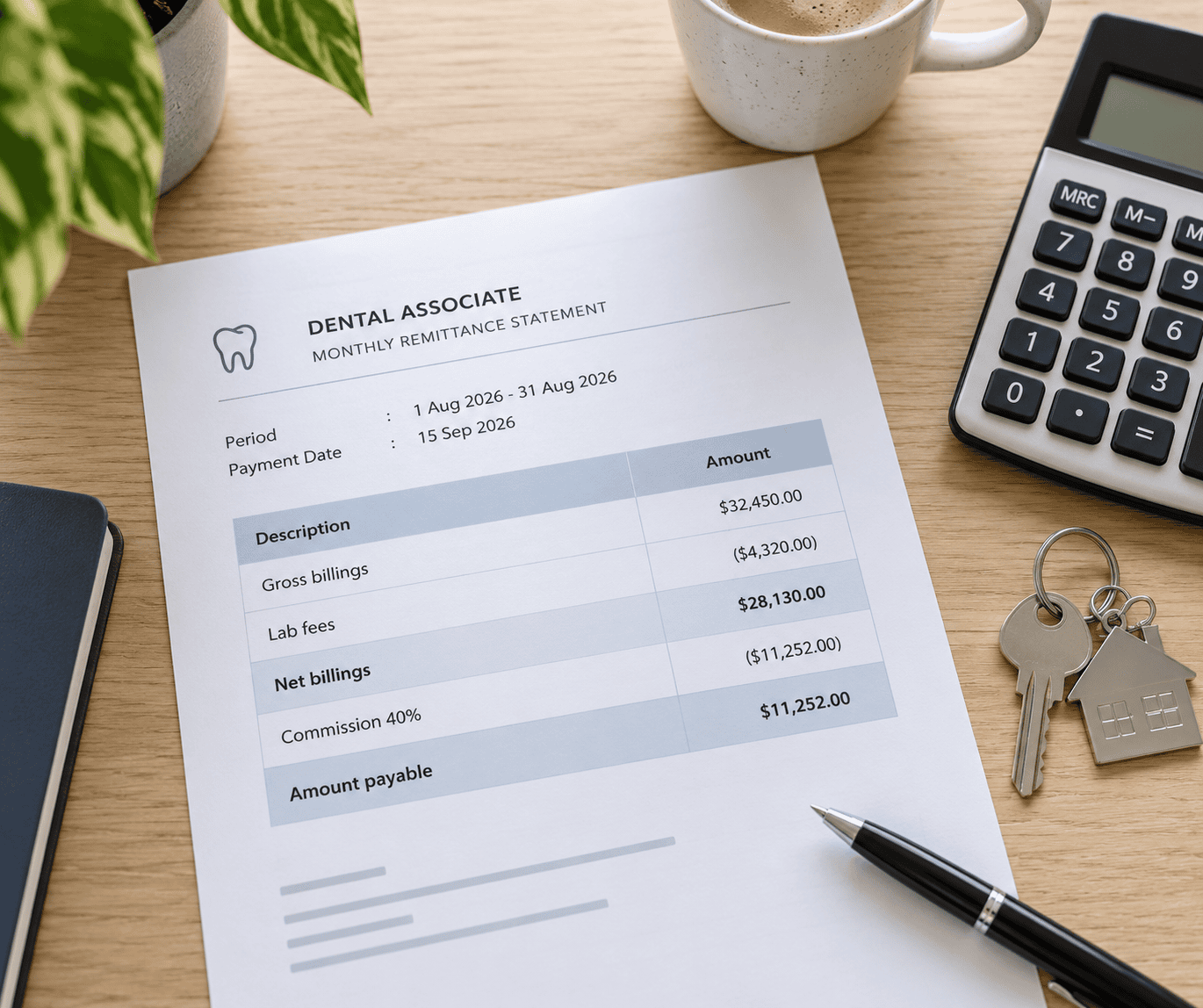
To a lender, that makes you self-employed, and self-employed income is where lender policies diverge most. Broadly, there are three camps:
- Reads your billings statements. Some lenders will assess a dentist on recent practice remittance statements or BAS, and are comfortable with one year of figures for a registered health professional. A dentist eighteen months out of university, billing well, is assessed on what they actually earn now.
- Wants two full years of tax returns. Others apply the standard self-employed rule: two years of returns, and they use the lower year or an average. If year one was your graduate year, that average can understate you badly.
- Treats you as a new business. A few will not assess an ABN under two years old at all. Same dentist, same billings, declined.
Same person, same remittance statements, three different answers. This is why the first bank you ask is not the final word on your position. If their policy is the third one, you get a no that has nothing to do with your actual capacity.
Matching how you are paid to a lender whose policy reads it properly is most of what we do on these files.
Practice owners
If you own the practice, the home loan is assessed on your share of the practice profit plus whatever you draw as salary, usually from the last two years of financials. Add-backs matter here: depreciation on equipment, one-off fit-out costs and interest on the practice loan can often be added back to your assessable income, and whether a lender does that changes the answer by a long way.
Owners also tend to carry a practice loan and equipment finance, and the way those are treated in the home loan assessment differs between lenders. If you are buying a home and a practice within a year or two of each other, the order matters and is worth planning. Our medical and dental practice loans page covers the practice side.
What the waiver is worth in real money
LMI runs between roughly 1% and 5% of the loan and climbs steeply as the deposit shrinks. Here is what a dentist avoids at a 10% deposit:
| Property value | Deposit | Approx. LMI avoided |
|---|---|---|
| $600,000 | 10% | ~$22,800 |
| $700,000 | 10% | ~$26,700 |
| $800,000 | 10% | ~$31,900 |
| $900,000 | 10% | ~$36,000 |
Estimates from a major lender’s published LMI calculator; every lender prices it differently, and at a 5% deposit the premium is considerably higher than the figures above. LMI is normally added to the loan rather than paid up front, so you also avoid paying interest on it for thirty years. The real saving is well above the headline number.
Who qualifies
You will generally need to be:
- Registered with AHPRA through the Dental Board of Australia as a dentist or dental specialist
- Practising — as an associate, a contractor, an employee or a practice owner
- Able to show your income in a form the chosen lender accepts
Dental specialists — orthodontists, oral surgeons, periodontists, prosthodontists, endodontists, paediatric dentists — qualify on the same or better terms. New graduates are often accepted on a signed associate agreement plus the first few months of remittances, at lenders that read billings. Oral health therapists, dental hygienists and dental prosthetists sit outside most dentist policies but may be covered under a lender’s broader allied health list; it is worth asking rather than assuming.
Doctors and medical specialists have their own page at home loans for doctors. Everyone else in healthcare — nurses, pharmacists, vets, allied health — is covered in our guide to medical professional home loans.
What you’ll need
Proof of AHPRA registration, photo ID, and a summary of your deposit and current debts, including any practice or equipment finance. For income: if you are an associate, your last six to twelve months of remittance statements and your most recent tax return; if you own the practice, two years of business and personal returns and the latest BAS. If you carry a HECS balance, bring the figure — it reduces borrowing capacity more than most people expect.
You can get a free report on where you stand before we speak, so the first call is about options rather than paperwork.
Want a sense of the numbers first? It takes about two minutes.
How the process works
1. Work out how your income reads. We look at your remittances or financials the way a lender will and identify which lenders will assess them in full. This step decides most dentist applications.
2. Match you to the lenders that waive for dentists at the deposit you have. The 90% list is long; the 95% list is short and has loan-size caps.
3. Get pre-approval before you make offers. It confirms the lender has accepted both your profession and your income evidence, and gives you a firm number to bid to.
4. Make your offer, then move to formal approval. With no mortgage insurer involved there is one fewer party to satisfy, which is why these files often move faster.
5. Review the structure after settlement. Particularly if a practice purchase or an investment property is on the horizon — how the home loan is set up now affects both.
Investment properties
Several lenders extend the dentist waiver to investment loans, usually at a lower maximum — 90% rather than 95% — and a few limit it to owner-occupied only. If you are buying an investment property before your own home, or building a portfolio alongside a practice, tell us early. The choice of lender for the first property shapes what is possible on the second.
Why use a Soren Financial broker?
We compare more than 50 lenders, and the policies that decide home loans for dentists — which registration categories qualify, how associate billings are read, how many years of figures are needed, what the 95% cap is — change without notice and are not published in one place. Our job is to find the lender whose rules fit the way you are paid, then carry the application through to settlement so you are not chasing paperwork between patients. If you would rather know who you are dealing with first, have a look at the team behind Soren.

FAQs
How much deposit does a dentist need?
As little as 5% at the lenders that offer the 95% tier, or 10% at the wider group. A standard borrower needs 20% to avoid LMI.
Is there a minimum income for the dentist LMI waiver?
At most lenders, no — dentists are treated like doctors, where registration alone qualifies you. The question is not whether you earn enough but whether the lender will count the way you earn it.
I’m an associate paid a percentage of billings. Do I count as self-employed?
Usually yes, because you are paid through your own ABN. Some lenders will assess you on recent remittance statements with as little as one year of history; others want two years of tax returns. That difference decides a lot of applications.
I graduated recently. Can I still get the waiver?
Often. Lenders that read billings will accept a signed associate agreement and the first months of remittances. Lenders that want two years of returns will not — so the choice of lender is the whole answer.
Does it apply outside Sydney?
Yes. The waiver sits in lender policy and applies across Australia — Brisbane, Melbourne, Perth, regional. What can change is the property: some lenders reduce the maximum LVR in postcodes they treat as higher risk. That is about the property, not about you.
I was declined by my own bank. Is that the end of it?
No, and with dentists it is usually the ABN rule rather than your capacity. A decline reflects one lender’s policy on how long you have been contracting or how many years of returns they want, not what you can actually afford. It is regularly worth a second look elsewhere.
This information is general and does not take your personal circumstances into account. Eligibility, rates and LMI waivers are set by individual lenders and can change.
Ready to see your options? Answer a few quick questions and we will show you where you stand.
Dentists are on almost every lender’s medical list, but the wider healthcare picture is messier. Our guide to mortgages for healthcare professionals sets out which roles each lender counts, and what the waiver is worth.