
Commercial property loan experts Sydney
Whether you’re buying premises for your own business, building an investment portfolio or developing commercial property, Soren Financial can help you secure the right commercial property loan for your needs.
Not sure how lenders will assess your deal? Answer a few quick questions and see which commercial loan options could suit you.
Why choose Soren Financial for commercial lending?
Fast approvals: Most commercial loans are approved within 2–8 weeks, and straightforward applications under $1.5 million can be approved by specialist lenders in as little as 1–2 business days | More choice: We compare commercial loan options from 20+ lenders, including major banks and specialist lenders. |
End-to-end support: We take the time to understand your situation and guide you through the process from application to settlement | Expert guidance: With more than 20 years of experience in commercial property finance, we’ll help you structure your finance to maximise borrowing power and cash flow |
What’s a commercial property loan?
A commercial property loan is a type of investment loan used to buy a business or commercial property like a warehouse, retail space, or offices.
The main ways commercial property loans differ from residential property loans include:
- Higher minimum deposit requirements, often around 30%
- Commercial loans have higher interest rates
- Lenders consider the property’s rental income, business cash flow and the borrower’s financial position when assessing the loan
Commercial property loans are assessed using the Debt Service Coverage Ratio (DSCR). This measure helps lenders determine whether the income generated by the property or business is sufficient to cover the loan repayments.

Financial Services Expert
“Commercial lending is very different from a standard home loan. The biggest mistake borrowers make is assuming every lender will assess the same business or property the same way. In reality, loan terms, deposit requirements, security options and how income is assessed can vary significantly between lenders.
A well-structured commercial loan should do more than just get approved. It should support cash flow, protect borrowing capacity and give business owners or investors the flexibility they need as their goals change.”
Mansour Soltani – Director Soren Financial
Available commercial loan features from lenders we compare
At Soren Financial, we consider a range of options and lenders to ensure that our clients have access to the best deals and loan packages to suit their commercial property purchase needs. The lenders we compare offer the following commercial loan features.
|
|
How to apply for a commercial property loan
Before applying for a commercial property loan, there are a few steps you can take to improve your chances of approval and help the application process run smoothly.

Speak to a commercial mortgage broker. A commercial broker can compare lenders, interest rates and loan features to find a finance solution that suits your needs. They can also help you understand your borrowing power and prepare a strong application.
Review your credit history. Make sure your credit score is in good shape and reduce any outstanding debts where possible. A strong credit history, with no missed or overdue repayments, can improve your borrowing power and strengthen your application.
Have your deposit ready. The deposit you’ll need depends on the lender, the type of commercial property and your financial position. In many cases, lenders will finance up to 70% of the property’s value, meaning you’ll typically need a deposit of at least 30%. Some lenders may require a larger deposit, so it’s worth saving as much as you can.
Gather your documents. Have your personal, business and financial documents ready to be accessed. Organising your paperwork before you apply can help speed up the approval process.
Documents you'll need to apply for a commercial property loan
Your broker and lender will ask you to provide a range of personal, financial and property documents as part of the commercial loan application process.
Personal documents may include:
- Certified photo identification, such as a passport or driver’s licence
- Certified photo ID for any co-borrowers or guarantors
Financial and business documents may include:
- Personal and business tax returns, along with ATO Notices of Assessment (typically for the past two years)
- Financial statements, including profit and loss statements, balance sheets and cash flow statements (typically for the past two years)
- Personal and business asset and liability statements
- Business bank statements (generally for the past six months)
- Business registration documents, such as your ABN, ASIC company extract or trust deed (where applicable)
- Details of any existing loans or credit facilities
- Business plans or cash flow forecasts (where applicable)
Property documents may include:
- The property address
- The purchase price
- A signed contract of sale (if available)
- Current lease or tenancy agreements (for leased commercial properties)
Commercial property finance solutions
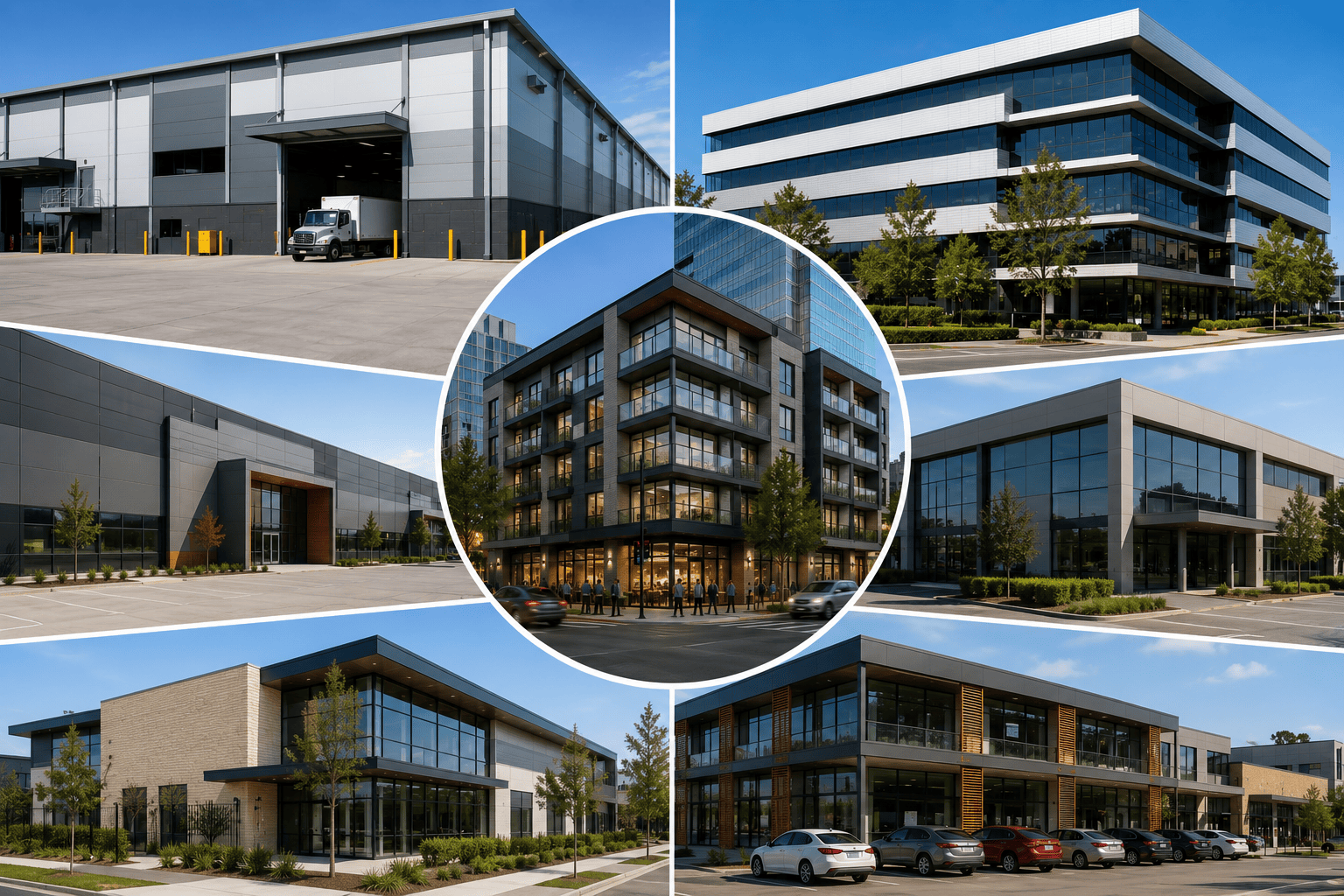
Soren Financial can help you access commercial property finance solutions across a variety of industries and sectors, including but not limited to:
- industrial property finance
- office finance
- retail property finance
- medical and healthcare property finance
- childcare centre finance
- mixed-use property finance
Development finance
Our team can also support development finance applications, including:
- construction loans
- land subdivision finance
- property development loans
Business finance
Additionally, we help clients secure business finance packages, including:
- working capital loans
- debtor & invoice finance
- trade finance
- equipment & asset finance
Commercial property loan FAQs
Are commercial property loan interest rates fixed or variable?
Commercial property loans are available with either fixed or variable interest rates, depending on the lender and loan product. Split loans are also available.
A fixed-rate commercial loan locks in your interest rate for a set period up to five years. This provides repayment certainty if interest rates rise. However, you won’t benefit if rates fall during the fixed term, and break costs or early repayment fees will apply.
A variable-rate commercial loan has an interest rate that can rise or fall over the life of the loan. While repayments may increase if interest rates go up, you’ll generally have greater flexibility to make additional repayments, redraw funds (if available) or refinance without the same restrictions as a fixed-rate loan.
How long does it take to get approved for a commercial property loan?
The approval process for a commercial property loan can vary depending on the lender, the complexity of the application, and how quickly you can provide the required documentation. In most cases, approval takes between 2 and 8 weeks. However, some specialist lenders can approve straightforward applications in as little as 1–2 business days, while more complex transactions may take up to 16 weeks.
How much deposit do I need for a commercial property loan?
The deposit you’ll need depends on the property you’re buying, your financial position and the lender’s requirements. Commercial property loans typically require a larger deposit than residential home loans, with many lenders financing up to 70% of the property’s value. As a guide, it’s worth budgeting for a deposit of around 30% of the purchase price, plus funds to cover stamp duty and other upfront costs.
Do I need to pay Lenders Mortgage Insurance (LMI) on a commercial loan?
No, you do not pay Lenders Mortgage Insurance (LMI) on a commercial property loan. Instead, commercial lenders typically require a larger deposit to reduce their risk. LMI only applies to residential home loans.
What fees are involved with a commercial property loan?
In addition to your deposit, there are several upfront costs to budget for when taking out a commercial property loan. Depending on the lender and the size of the loan, these may include:
- Application and loan establishment fees, which can range from around $1,500 to $5,000 for smaller loans or 0.25% to 0.75% of the loan amount for larger facilities.
- Property valuation fees, which can cost up to $5,000 depending on the type and complexity of the property.
- Legal fees, typically ranging from $1,000 to $3,000.
You’ll also need to budget for stamp duty, mortgage registration fees and any other professional costs associated with the purchase, like conveyancing, accounting advice or building inspections.
If you use a commercial mortgage broker, ask upfront how they’re paid, as some brokers receive a commission from the lender while others may charge a brokerage fee.
Can I get a commercial property loan with bad credit?
Yes, it’s possible to get a commercial property loan with bad credit, but your options may be more limited.
Lenders will assess the nature of your credit history, your current financial position, the strength of your business and the security offered. Depending on your circumstances, you may need to provide a larger deposit, pay a higher interest rate or offer additional security, such as another property. In some cases, a guarantor may also strengthen your application.
Working with an experienced commercial mortgage broker can help if you have a poor credit history. Brokers have access to a wide range of lenders, including specialist lenders that may consider applications declined by the major banks, and can help identify the most suitable loan options for your circumstances.
Not all commercial property borrows the same
People tend to think of commercial property as one category. Lenders don’t. What you’re buying and where it is will drive how much you can borrow more than almost anything else about you.
A worked example. Say you’re looking at a retail shop in a strip of shops. If that strip has a lot of vacancies, you’ll struggle to find a lender who’ll offer you a decent loan-to-value ratio, no matter how strong you are as a borrower. The vacancy rate tells the lender the location is soft, which tells them re-letting your tenant would be hard, which tells them the security is weaker than the price suggests.
Same buyer, same money, different street, completely different answer.
So before you get attached to a property, it’s worth a quick conversation about whether the asset type and the location will actually fund. That’s a five-minute call and it saves a lot of wasted effort.
The lease is part of the security
When a lender looks at a tenanted commercial property they’re looking at the income it produces, and the income is only as reliable as the lease behind it.
The tenant’s industry, how exposed that industry currently is, and how long the lease has left all feed into what the lender will lend. A long lease to a stable tenant strengthens the deal. A short lease, or a tenant in a sector under pressure, weakens it.
None of that shows up in the asking price. It shows up in your loan-to-value ratio.
Want to talk through your commercial purchase?
Book a time that suits and we’ll give you a call.
Book a CallIf your file is self-employed or your income needs explaining, a specialist non-bank lender may beat the banks on approval even if not on rate. Our Thinktank review is a worked example of when that trade is worth making.