
Should I invest in real estate in 2026? I get this question weekly, and the honest answer has two halves that are both true: the fundamentals for property investors are strong, and the cost of getting it wrong is higher than it has been in years. Anyone who gives you only one half is selling something.
Want the answer for your actual situation instead of the internet’s? Email startnow@sorenfinancial.com and we will run your numbers properly.
The case for investing in 2026
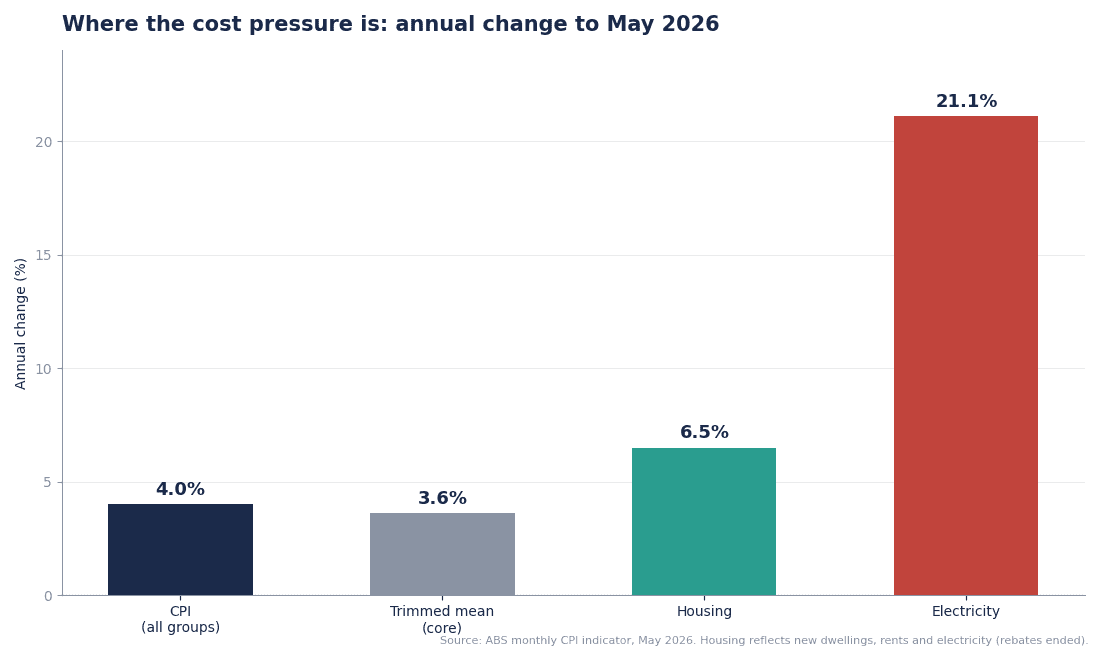
Rents are rising — housing inflation is running at 6.5% against headline CPI of 4% — and the supply of new homes is not keeping up with the people who need them, a squeeze we unpacked in our property market update. Investors have noticed: broker-settled lending hit $124.88 billion in the March quarter, up more than 25% on the year, continuing the surge we covered when investor loans took off. Tight supply plus rising rents is the environment long-term investors want to buy into.
The case against (or: why your accountant looks nervous)
Money is not cheap. With the cash rate at 4.35% and investor loan rates above owner-occupier rates, a negatively geared property costs real cashflow every month while you wait for growth. Your borrowing capacity is also smaller than it was in January — each of this year’s three hikes trimmed roughly 2% off the maximum, as we showed in our borrowing capacity piece. And holding costs — insurance, maintenance, rates — have been climbing with everything else. If your buffer is thin, 2026 is an unforgiving year to learn that lesson.
So should I invest in real estate or wait?
Wrong question. The better question is: do the numbers on a specific property, at today’s rates, with your income and buffers, produce an investment you can hold comfortably for 10 years? If yes, the market timing debate mostly takes care of itself — supply is not being fixed quickly, and waiting for cheaper prices while rates trim your capacity is the classic trap. If no, no amount of market optimism fixes a property you cannot afford to hold. That is the whole framework: buy on numbers, not vibes, and stress-test at your rate plus the 3% APRA buffer, not the advertised rate.
Three practical moves before you decide
First, get your real borrowing capacity confirmed — not last year’s pre-approval. Second, run the cashflow on our calculators including rates 0.5% higher, because the OurTop10 Rate Prediction Index still prices a 22.3% chance of another hike at the next meeting and 0% chance of a cut. Third, decide your structure (interest-only vs P&I, offset, entity) before you bid, not after — unwinding a bad structure costs far more than setting it up right.
Moral of the story: should I invest in real estate in 2026 is a maths question wearing a philosophy costume. Bring us the maths at startnow@sorenfinancial.com and we will give you a real answer. Client reviews on OurTop10.
About the author

Mansour Soltani
Founder and CEO, Soren Financial
Mansour leads Soren Financial, working with clients across home loans, refinancing and property investment. A regular media contributor to ABC, Domain and Australian Broker, he holds a Certificate IV and Diploma in Finance and Mortgage Broking.
View full profile →